
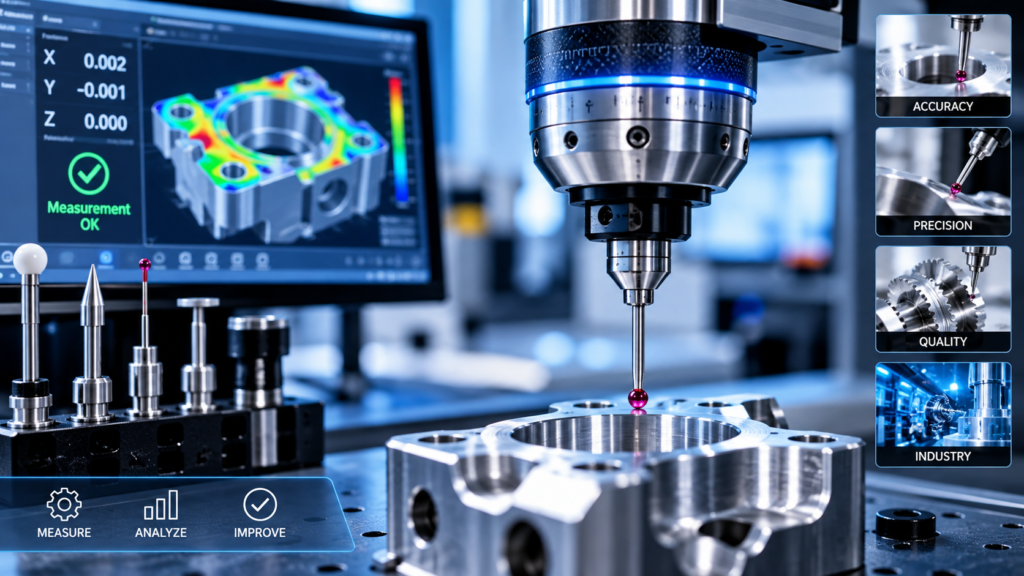

If you have come across the term Messonde in an engineering document, translated manual, product description, or scientific reference, its meaning may not be immediately obvious. In technical contexts, Messonde generally refers to the German term Messsonde, which means a measuring probe or measuring device. German-English technical terminology sources translate Messsonde as terms such as “measuring probe,” “test probe,” “measuring head,” and “measuring sensor.”
A measuring probe is not necessarily one specific product. Instead, it describes a broad class of equipment used to obtain information about a physical or chemical property. Depending on its design, a probe can interact with a liquid, gas, solid, surface, machine, or other environment and provide a measurement to a larger instrument or control system.
What Does Messonde Mean?
The simplest way to understand Messonde is as a term connected with a measuring probe. However, there is an important spelling point: Messsonde is the established German technical form found in specialist terminology, while “Messonde” can appear as a shortened, translated, or search-oriented spelling.
The German technical dictionary LEO lists Messsonde with several English equivalents, including measuring probe, test probe, measuring head, and measuring sensor. This means the precise English wording depends on the application, rather than there being a single universal translation.
The German Federal Agency for Nature Conservation’s MeerThes terminology database also uses Messsonde/-Gerät and gives “Measuring Probe/Device” as an English alternative. Its related concepts include CTD measuring probes, pH meters, oxygen probes, and other specialized measurement equipment.
So, when you encounter Messonde, the surrounding technical context matters. A document about water quality, for example, may be referring to a very different type of probe than a document about industrial materials or gas measurement.
Is Messonde the Same as Messsonde?
Not exactly in terms of standard terminology.
Messsonde is the spelling you are more likely to encounter in German technical documentation. Messonde may appear when the word has been shortened, translated imperfectly, typed differently, or reproduced from online material.
This distinction is useful when searching for manuals, replacement parts, specifications, or manufacturer documentation. If a search for Messonde produces unclear results, searching for Messsonde together with the specific measurement type can provide much more precise information.
For example, a technical search might combine Messsonde with terms related to temperature, oxygen, pressure, conductivity, thickness, or another measurement.
The spelling alone also does not identify a particular instrument. Actual specifications are more informative than the keyword itself.
What Is a Measuring Probe?
A measuring probe is the part of a measurement system that is positioned where a physical or chemical quantity needs to be detected.
The probe may contain a sensing element that responds to a change in its surroundings. Depending on the technology, that response can involve temperature, electrical resistance, conductivity, pressure, light, radiation, chemical concentration, or another measurable property.
Connected electronics can then process the resulting signal. A meter may display the result, while a controller or computer can record, transmit, analyze, or use the information to control another process.
This is why a measuring probe should not automatically be confused with an entire measuring instrument. In some systems, the probe is one component of a larger setup.
A practical example appears in specialized measurement equipment from the German National Metrology Institute, PTB. One PTB system used a measuring probe for determining temperature and thermal conductivity in small material samples. The probe used a resistance element whose behavior changed when it interacted thermally with the material being examined.
How Does a Messonde Work?
The operating principle depends on what the probe is designed to measure. No single sensing technology applies to every Messonde.
In a temperature application, the sensing element changes predictably as temperature changes. Electronics interpret that change and convert it into a temperature reading.
In conductivity measurement, the probe can determine how readily a material or solution conducts electricity. In pressure measurement, the sensing structure responds to mechanical force. Other systems use optical, magnetic, ultrasonic, electrochemical, or other measurement principles.
The general process is nevertheless similar:
The probe is placed at the measurement point, the sensing element responds to the target property, the system converts that response into a signal, and connected equipment interprets the signal as a usable measurement.
Some probes are designed for direct contact. Others operate without physical contact or are protected inside a housing. The environment determines the appropriate construction.
Common Types of Measuring Probes
Because Messonde can refer broadly to measuring-probe technology, its physical form varies considerably.
Temperature probes detect thermal conditions and are used in laboratories, industrial equipment, environmental systems, and many other applications.
Pressure probes measure mechanical pressure and can be incorporated into equipment where pressure must be monitored continuously or checked at a specific point.
Gas and oxygen probes are used when you need to determine the concentration or presence of a gas. Their construction depends heavily on the gas and operating environment.
Conductivity and pH probes are common in liquid measurement. The BfN MeerThes terminology database specifically identifies pH meters and oxygen probes among narrower concepts related to Messsonde/-Gerät.
Ultrasonic measuring probes are another specialized category. Technical catalogs list probes designed for material-thickness measurements, with different frequencies, dimensions, temperature capabilities, and measurement ranges depending on the application.
The key point is that the name Messonde does not tell you which sensing method is being used. The measurement task does.
Messonde in Industrial Engineering
Industrial measurement is one of the clearest areas where measuring probes become essential.
Manufacturing and processing systems often need information about temperature, pressure, material thickness, gas conditions, fluid properties, or other process variables. A measuring probe can collect that information at the point where the condition actually occurs.
The probe’s construction must match the environment. A probe used around high temperatures requires different materials and protection from one intended for a laboratory liquid. Vibration, moisture, chemicals, dust, mechanical impact, and electrical conditions can all affect the choice.
Industrial manufacturers also produce application-specific probes rather than one universal design. For example, Helmut Fischer offers Messsonde products for coating and material-thickness measurements using magnetic-inductive and eddy-current methods. Some of these probes have defined measurement ranges and are designed to work with particular measuring instruments.
That illustrates an important practical lesson: a probe is normally selected as part of a complete measurement system, not simply because its name sounds suitable.
Measuring Probes in Scientific and Laboratory Work
Scientific measurement often requires probes that can work with small samples, controlled environments, or specialized materials.
A laboratory Messonde may measure temperature, conductivity, chemical properties, material characteristics, or other quantities. The probe’s dimensions and sensing method can be particularly important when the sample is small.
PTB has documented measuring-probe technology for temperature and thermal-conductivity measurements on small material samples. Its described system used a compact probe and a resistance-based sensing principle to obtain thermal information.
Marine and environmental science provide another example. The BfN terminology database includes CTD measuring probes among the narrower concepts associated with measuring-probe equipment.
This shows why it is more accurate to think of Messonde as a category or technical reference rather than the name of a single universal sensor.
Is Messonde the Same as a Sensor?
The terms are closely related, but they are not always interchangeable.
A sensor generally refers to an element or device that detects a physical or chemical change. A probe often describes the assembly positioned at the measurement location and may contain the sensor, housing, connections, or other components needed to obtain the measurement.
In everyday technical writing, manufacturers may use sensor and probe somewhat differently depending on the product.
For that reason, when identifying a Messonde, the specification sheet is more useful than assuming that “probe” and “sensor” always describe the same component.
A product can contain a sensing element inside a larger probe assembly. The assembly may then connect to a measuring instrument, controller, data logger, or computer.
Messonde vs. Radiosonde
One common source of confusion is the word radiosonde.
A radiosonde is a specialized atmospheric instrument used with weather balloons to measure temperature, pressure, and humidity as it travels through the atmosphere. It is therefore much more specific than the general idea of a measuring probe.
A Messonde, by contrast, is not automatically a radiosonde. The German technical terminology covers many kinds of measuring equipment, including specialized probes used in environmental and scientific work. The BfN terminology system, for example, lists several different types under Messsonde/-Gerät rather than treating the term as one particular atmospheric instrument.
The surrounding context is therefore essential. If the document discusses weather balloons and upper-atmosphere measurements, “radiosonde” may be the relevant term. If it discusses industrial inspection, water measurement, laboratory testing, or material analysis, another type of probe may be involved.
Why Accuracy and Calibration Matter
A measuring probe is only useful when its output is sufficiently reliable for the application.
Sensing technology, installation position, environmental conditions, aging, contamination, mechanical wear, and the measuring instrument connected to the probe can affect accuracy.
Calibration is therefore an important part of many measurement systems. It provides a way to compare the measurement with a known reference or established standard and determine whether the system is producing an appropriate result.
The need for calibration can be especially clear in specialized industrial probes. For example, some Helmut Fischer Messsonde products are supplied with calibration foils and are intended to operate with specified measuring instruments.
The correct procedure depends on the probe and manufacturer. Calibration should therefore follow the relevant technical documentation rather than a generic procedure copied from another sensor type.
How to Choose the Right Measuring Probe
Choosing a Messonde starts with the measurement itself.
First determine exactly what needs to be measured. Temperature, pressure, oxygen, conductivity, material thickness, humidity, and fluid level require different sensing technologies.
Then consider the operating environment. Maximum and minimum temperature, chemical exposure, moisture, pressure, vibration, mechanical contact, and available installation space can all influence the right probe.
Compatibility is equally important. The probe may require a particular connector, measuring instrument, signal type, adapter, or controller. A technically suitable sensing element can still be unusable if it cannot communicate with the rest of the measurement system.
For specialized products, check the manufacturer’s specifications for measurement range, accuracy, response characteristics, operating conditions, connection requirements, and calibration method.
This approach is more reliable than selecting equipment based only on the term Messonde.
What Does Messonde Mean in a Technical Document?
If you encounter Messonde in a translated technical file, the safest interpretation is to examine the surrounding terminology.
Look for the quantity being measured, the equipment model, the manufacturer, the installation location, and the German spelling Messsonde. Those details can reveal whether the document is discussing a temperature probe, an industrial inspection probe, a chemical measurement device, or another specialized instrument.
Searching for both spellings can also help you locate the original German documentation.
This is particularly useful when dealing with older manuals, translated product pages, engineering records, or spare-parts information. The exact word may be less important than the technical specification attached to it.
Conclusion
Messonde is best understood through its technical context. In many engineering and scientific contexts, it points to the German term Messsonde, used for measuring-probe or measuring-device concepts. Established terminology sources translate Messsonde into several related English expressions, including measuring probe and measuring sensor.
The key point is that a Messsonde is not a single universal product. Measuring probes can be designed for temperature, pressure, conductivity, oxygen, material thickness, environmental measurements, and many other applications. Their construction, sensing principle, accuracy, and compatibility depend on the job.
If you see the word in a manual or on a product page, look beyond the spelling. The measurement being performed, the equipment connected to the probe, and the manufacturer’s specifications will tell you far more about what the device actually does.
(FAQs)
What is Messonde?
Messonde is generally used as a term for a measuring probe, particularly the German technical term Messsonde. Depending on context, it can refer to equipment used to detect or measure a physical or chemical property. The established German spelling is Messsonde.
What is Messsonde in English?
Messsonde can be translated into English as measuring probe, test probe, measuring head, or measuring sensor, depending on the technical context. LEO lists these as English equivalents for the German term.
Is Messonde a specific type of sensor?
Not necessarily. Messonde does not refer to a single sensing technology or a specific product. It is better understood in context as a reference to measuring-probe equipment. Different probes can measure temperature, pressure, conductivity, gas conditions, material thickness, and other properties.
Is a Messonde the same as a radiosonde?
No. A radiosonde is a specialized atmospheric instrument used with weather balloons. A measuring probe is a much broader category, and Messonde should not automatically be interpreted as a radiosonde.
Why is Messonde sometimes written Messsonde?
Messsonde is the established German technical spelling. The shorter spelling can appear in translated material, online searches, or copied text. When researching equipment, searching both terms can help locate the original technical documentation.
What should I check before buying a measuring probe?
Check the measurement type, measurement range, accuracy, operating environment, connection, compatibility with the measuring instrument, response characteristics, and calibration requirements. Prioritize the product’s technical documentation over the name alone.