
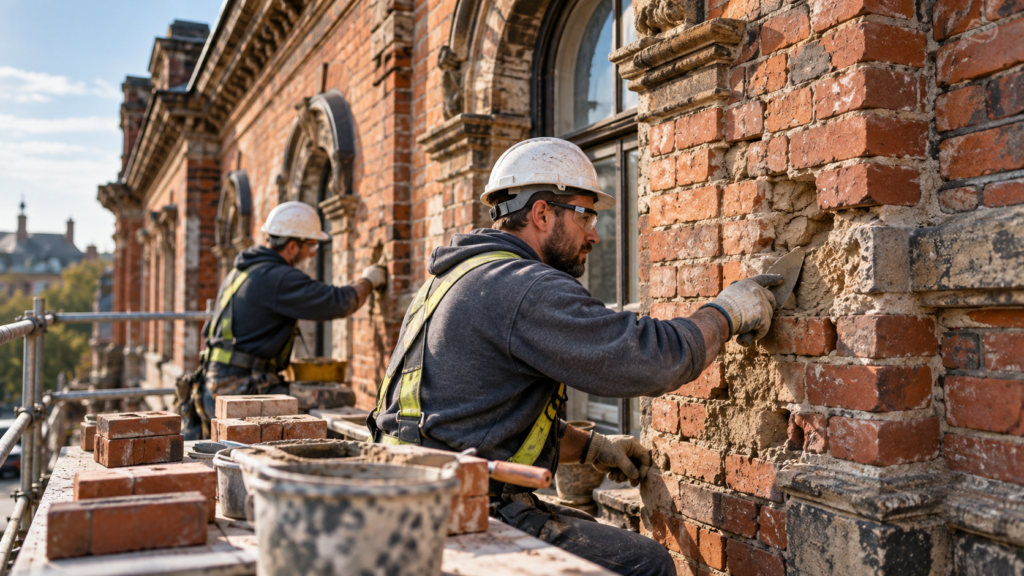

A builder looks at the crumbling joints on a Victorian terrace and offers to run fresh cement through them in a couple of days. The owner hesitates, because the house next door had the same job done and its brick faces started flaking within a few winters. Before saying yes, it’s worth hearing from masonry specialists who deal with old walls every week.
That neighbour’s experience isn’t bad luck. It’s what tends to happen when a wall built to breathe gets sealed with something harder than the brick around it. The damage is slow and expensive to reverse, and it often starts with a well-meant repair.
Why older buildings need masonry specialists rather than general builders
Most London houses built before the First World War have solid walls with no cavity. They cope with damp by letting it in and letting it out again, mostly through soft mortar joints. It’s a simple system, and it has worked for well over a century.
A general builder is usually trained in modern construction, where cement mortar, cavity walls and membranes keep water out altogether. Those habits make sense on a new extension. On a solid Victorian or Edwardian wall they can quietly trap moisture inside the masonry.
A specialist starts somewhere else. They’ll want to know what the wall is made of, how it was first pointed, where the damp comes from and why the stone on the sills is peeling. Only then will they suggest any work. Sometimes the right answer is a smaller job than you expected.
A few signs usually mean the work belongs with a specialist:
- Mortar that crumbles to sand when you scrape it with a key, which suggests the original lime has worn out and needs replacing like for like.
- Brick faces spalling around hard grey joints, a common sign that earlier cement repointing is forcing moisture out through the brick itself.
- Stone sills, lintels or copings delaminating in thin layers, which often points to water getting in from above or to an unsuitable earlier repair.
- Dark streaks that come back soon after cleaning, suggesting a drainage or detailing fault that no amount of washing will ever solve.
Lime versus cement and why the mortar choice matters
Lime mortar is softer and more porous than the bricks it holds together, and that’s deliberate. Moisture moving through the wall finds its way out via the joints. When the wall shifts with the seasons, the joints take the strain, and over decades the mortar wears back and gets renewed while the bricks survive.
Cement flips that relationship. It’s harder and far less permeable, so moisture that used to escape through the joints is pushed into the brick instead. In a frost, that trapped water expands and the face of the brick pops off, while the mortar looks fine for years.
None of this means cement has no place. Harder mixes suit modern masonry, and plenty of mid-twentieth-century houses were built with them from the start. Masonry Brothers, for instance, work with both traditional lime mortars and modern mixes, choosing according to each building’s age, style and requirements, and they use lime for repointing and render as well.
If you’re comparing quotes, ask each firm which mortar they’d use and why. A vague answer, or “our standard mix”, tells you a lot.
Natural and cast stone behave differently
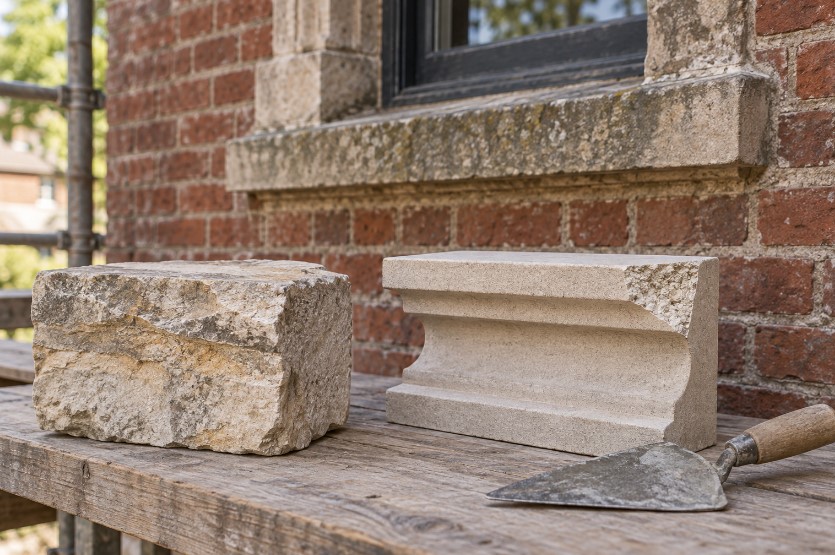
Stone adds another layer. Many period houses combine natural stone details, such as sills, window surrounds and steps, with cast stone, a concrete-based product moulded to look like the real thing. From the pavement the two can appear almost identical.
They don’t age the same way, though. Natural limestone and sandstone weather gradually and suffer when salts or pollution build up in the surface. Cast stone is more prone to cracking, and where there’s steel reinforcement inside, rust can split a piece apart from within.
The fixes differ too. A decayed natural stone sill might be cut back and patched with a tinted lime-based repair mortar, or replaced with a new piece of matching stone, whereas cast stone calls for its own methods. Anyone quoting for the work should be able to tell you which one you’ve got.
Cleaning is where stone gets hurt most often. High-pressure water and harsh chemicals can strip the weathered outer skin and open the surface to faster decay. Gentler methods, such as low-pressure, high-temperature steam, lift dirt and biological growth without blasting the stone.
Listed and historic buildings raise the stakes
If your house is listed, the rules change. Work that affects its character, which can include repointing in a different mortar or replacing original stone, may need listed building consent from the local council. Doing it without consent is a criminal offence in England, however good the intention.
Conservation areas bring their own controls, especially on front elevations. Even where no consent is needed, conservation officers generally expect like-for-like repairs, with the same materials, the same joint profile and a mortar colour that blends in.
Heritage experience counts here more than anywhere. Masonry Brothers, a family-run firm working across London and the surrounding areas, say their heritage stonemasons are experienced in conservation work and comply with the regulatory requirements for listed and historic buildings. Whoever you hire, that’s the standard to look for.
Keep copies of everything, from photos and specifications to any consent. They’ll help when you sell, and they’ll help whoever works on the wall next.
What to ask stone and masonry specialists before hiring them
Stone and masonry specialists who really know old buildings won’t mind being questioned. Their answers show quickly whether someone understands period walls or is simply comfortable around them.
At the first meeting, it’s worth asking about these points:
- The cause of the damage, because a proper diagnosis should come before anyone prices up repointing a whole elevation.
- Their choice of mortar and how they’ll match its colour and texture, ideally on a small test panel you can look at first.
- The method for removing old pointing. Grinding out hard cement carelessly can damage brick edges, so ask whether they’ll rake it out by hand.
- Photos of similar houses they’ve worked on, especially listed or conservation-area jobs, since comparable work says more than general promises.
- A realistic timeline. Schedules depend on scope and complexity, so one given after an inspection deserves more trust than a guess over the phone.
It also pays to prepare for the first visit. Take photos of the problem areas in different weather, note when the damp or staining gets worse and dig out any paperwork on earlier repairs. With that in hand, a specialist can tell you far more in one visit, and you’ll be better placed to judge whose advice actually fits your wall.