
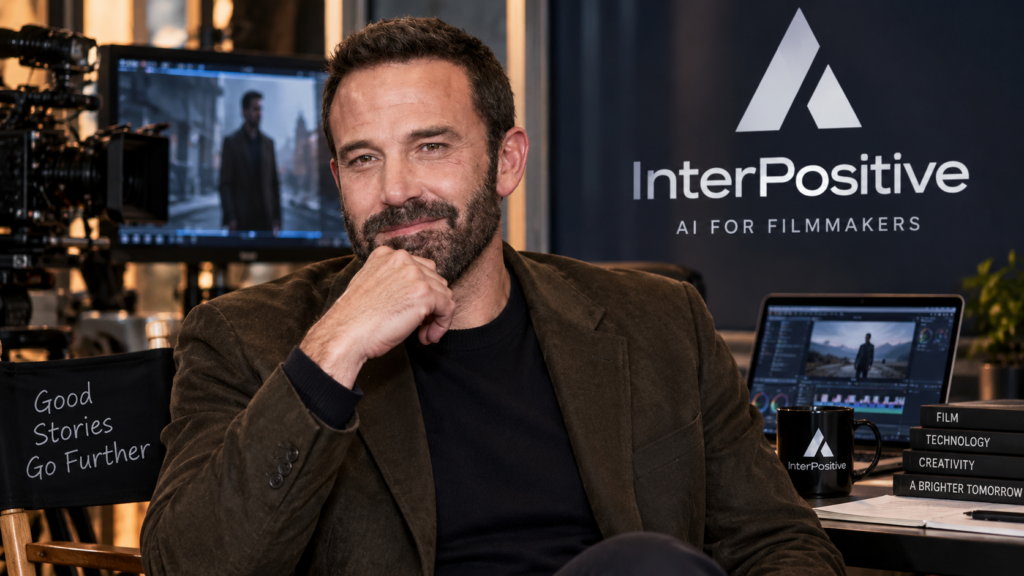

InterPositive is the filmmaking technology company Ben Affleck founded that became one of Netflix’s most closely watched technology acquisitions in 2026. Built around artificial intelligence rather than traditional film production, the company developed tools intended to help filmmakers solve practical production and post-production problems while keeping creative decisions in human hands. Netflix announced the acquisition in March 2026, bringing InterPositive’s team into the streaming company and appointing Affleck as a senior adviser.
The deal initially attracted attention because InterPositive had operated with relatively little public visibility since its founding in 2022. It became even more significant after Netflix disclosed in a regulatory filing that the March acquisition had a total purchase price of approximately $587 million in cash.
For readers trying to understand the business behind the headline, the important question is not simply why Netflix bought a company connected to a Hollywood star. It is what InterPositive’s technology does, how it fits Netflix’s wider AI strategy, and whether filmmaker-focused AI can reduce production costs without undermining creative control.
Quick Facts
| Detail | Information |
|---|---|
| Company | InterPositive |
| Industry | Filmmaking technology / artificial intelligence |
| Founded | 2022 |
| Founder & CEO | Ben Affleck |
| Business focus | AI-powered tools for filmmakers |
| Acquisition | Acquired by Netflix in March 2026 |
| Purchase price | Approximately $587 million in cash |
| Parent company | Netflix |
| Post-acquisition role | InterPositive team joined Netflix; Affleck became senior adviser |
| Primary technology | Production-specific AI for filmmaking and post-production |
Netflix describes InterPositive as a filmmaking technology company developing AI-powered tools “built by and for filmmakers.” Affleck founded the company after becoming concerned that early AI systems did not adequately understand the practical realities of film production.
What Is InterPositive and What Does It Do?
InterPositive was created to apply AI to real filmmaking workflows, not to replace filmmaking with text-to-video generation. That distinction is central to understanding the company’s strategy.
Affleck has explained that he began exploring the technology in 2022 after observing AI’s rapid development and seeing limitations in models designed to create images or video without the context of a specific production. He responded by building a system around filmmaking itself, including the visual logic, continuity requirements, and production conditions directors and crews deal with on actual projects.
The company can train its model using footage, or “dailies,” from a particular film or television production. This lets the system learn the project’s visual characteristics and editorial consistency rather than relying solely on a generalized model.
In practical terms, the technology can assist with tasks such as correcting lighting, adjusting color, reframing shots, enhancing or replacing backgrounds, addressing missing shots, and creating visual effects. These are largely production and post-production problems, not attempts to generate an entire movie from a written prompt.
That production-specific approach is important commercially. A director needs an AI system that understands the specific film being made, not simply a tool that can generate an impressive standalone image.
How InterPositive’s AI Filmmaking Model Works
The core concept behind InterPositive is relatively straightforward: use information from an existing production to make AI more useful within that production.
Instead of asking a generalized model to invent a scene, filmmakers can provide the system with material from their own project. The resulting model is designed to understand visual logic and editorial consistency while operating within that production’s cinematic rules.
This can matter when a production encounters an expensive problem late in the process. A missing shot, an incorrect lighting condition, an unwanted background element, or a complicated visual-effects requirement can traditionally require additional filming, extensive visual-effects work, or other costly interventions.
AI does not eliminate those decisions. Instead, the business value lies in giving filmmakers another way to iterate on a shot. Netflix has described the technology as designed around creative control, with tools that let filmmakers explore and refine material while keeping artistic decisions with the creators.
That positioning also separates InterPositive from consumer-facing generative video systems. The company wasn’t primarily built to produce complete films from text prompts. Its proposition was much closer to an AI-assisted production and post-production platform.
Why Netflix Acquired InterPositive
Netflix’s interest in InterPositive makes more sense when viewed as part of its broader technology strategy.
The streaming company has increasingly used generative AI across different parts of its business, including recommendations, promotional assets and creative workflows. In its 2026 shareholder communications, Netflix said it was using GenAI to give creative partners better tools and identified its acquisition of InterPositive as a way to broaden those capabilities.
For Netflix, the attraction is potentially much larger than the standalone value of a small technology company. Netflix is one of the world’s largest buyers and producers of film and television content. Even modest improvements in production efficiency can become financially meaningful when applied across a large slate.
Netflix executives said in 2026 that generative AI had already been used in roughly 300 titles, with significant activity occurring in post-production. Ted Sarandos said the technology was being used particularly for complicated shots and sequences that could otherwise be difficult or expensive to produce.
That gives the acquisition a strategic logic: Netflix can develop the technology internally, test it across its own productions and potentially use the resulting efficiency gains to increase the value of its content investment.
InterPositive Acquisition: The $587 Million Question
When Netflix announced the acquisition in March 2026, it did not disclose financial terms. Months later, the company’s SEC filing provided the missing figure.
Netflix reported that it completed an acquisition in March for about $587 million, paid in cash. The filing did not name the acquired company in that particular acquisition note, but Netflix had separately identified its March acquisition of InterPositive, the AI filmmaking company founded by Affleck.
The $587 million figure should therefore be understood as the purchase price for the acquisition, not as Ben Affleck’s personal payout or a confirmed valuation of his individual ownership stake. Public information does not establish how much of that consideration went to Affleck personally, and equating the transaction value with his personal proceeds would be misleading.
The size of the transaction is nevertheless notable. It represents a substantial bet on a relatively young filmmaking technology business and illustrates how seriously Netflix views AI as a potential tool for improving the economics of content production.
The deal also brought the company’s team into Netflix. Industry reporting described the group as a small team of engineers, researchers, and creatives, while Affleck joined Netflix as a senior adviser.
InterPositive Business Model and Market Position
Before the acquisition, InterPositive was not presented as a conventional consumer software company with a mass-market subscription product. Its value was primarily tied to its filmmaking technology, research, and specialized production workflow.
That makes the acquisition different from a typical software purchase. Netflix was buying technology and expertise it could integrate directly into its own production ecosystem. The company has said it would make the technology available to creative partners rather than position it as a standalone commercial product sold broadly in an open marketplace.
The competitive environment is broad. Technology companies, visual-effects specialists, and entertainment businesses are developing AI filmmaking and post-production tools, while major platforms are also building proprietary systems. Companies such as OpenAI and Google have attracted attention with generative video technologies. Still, InterPositive occupies a different niche because it emphasizes production-specific filmmaking assistance rather than general-purpose video generation.
Its potential advantage is therefore not simply the quality of generated imagery. The more important question is controllability: can a system work consistently with a director’s existing footage, visual style and editorial requirements?
That distinction may matter most for professional productions, where consistency, rights, continuity, and creative approval can matter more than generating a visually impressive clip.
Risks and Challenges for Netflix and InterPositive
The acquisition does not remove the broader challenges surrounding AI in Hollywood.
One major issue is workforce disruption. Writers, actors, visual-effects artists, and other creative professionals have raised concerns about AI replacing human work or using creative material without appropriate consent. A system explicitly designed to assist filmmakers rather than replace them may reduce some of those concerns, but it does not eliminate the wider debate.
There are also technical risks. AI-generated or AI-assisted material must remain consistent with the original production. Small errors in lighting, movement, perspective, or continuity can become obvious to audiences and expensive to correct.
The $587 million purchase price creates another business consideration. Netflix will need the technology to generate enough strategic value to justify the acquisition, whether through lower production costs, faster workflows, improved visual effects, or the ability to make sequences that might otherwise have been cut.
The company itself has emphasized that the technology is still in an early stage. That means the long-term return on Netflix’s investment remains uncertain, not guaranteed.
The Future Outlook for InterPositive
InterPositive’s future is now closely tied to Netflix rather than an independent startup strategy. Its technology can potentially be tested against one of the world’s largest film and television production ecosystems, allowing Netflix to refine the tools using real-world creative workflows.
Netflix’s broader strategy suggests that AI will continue to play a role in production efficiency. The company has argued that better tools could allow creators to achieve higher-quality results more efficiently, while savings could potentially be redirected into additional programming.
For InterPositive, the most important measure of success will therefore not be how impressive the technology looks in demonstrations. It will be whether directors, editors, visual-effects teams and other production professionals actually find it useful enough to adopt repeatedly.
If Netflix can make AI assistance reliable, controllable and compatible with established filmmaking practices, the acquisition could become an important part of its long-term content strategy. If those tools fail to meet professional standards, the large acquisition price will look much harder to justify.
Conclusion
InterPositive represents a distinctive approach to Hollywood’s AI debate. Founded by Ben Affleck in 2022, the company focused on building AI tools around existing film and television productions rather than attempting to replace filmmaking with fully synthetic content. Netflix acquired the business in March 2026, brought its team in-house, and retained Affleck as a senior adviser.
The later disclosure of a $587 million cash purchase price shows that Netflix sees significant strategic value in filmmaker-focused AI. The investment is ultimately a bet on production efficiency, creative flexibility and better use of technology across a large content operation.
The key question now is execution. InterPositive has moved from a stealthy startup founded by a Hollywood filmmaker to a technology asset inside one of the world’s biggest entertainment companies. Its long-term importance will depend on whether that technology can deliver practical improvements while preserving the human judgment that remains central to filmmaking.
For more business news, company profiles, financial insights, and latest updates, visit DailyInfoz.co.uk.
(FAQs)
What is InterPositive?
InterPositive is a filmmaking technology company Ben Affleck founded in 2022. It developed AI-powered tools intended to assist film and television professionals with production and post-production tasks while keeping creative decisions with filmmakers.
Who founded InterPositive?
Ben Affleck founded InterPositive and described himself as the company’s founder and CEO before Netflix acquired it. Affleck began developing the business after examining how emerging AI technology could be adapted to professional filmmaking.
How much did Netflix pay for InterPositive?
Netflix disclosed that it completed a March 2026 acquisition for approximately $587 million in cash. The SEC filing does not name the target in the acquisition note, but Netflix separately identified its March acquisition of InterPositive.
What does InterPositive’s AI technology do?
The technology is designed to work with footage from a specific film or television production. It can assist with tasks including lighting corrections, color adjustments, reframing, background changes, missing shots, and visual effects rather than simply generating an entire movie from a text prompt.
Is InterPositive still an independent company?
No. Netflix acquired InterPositive in March 2026 and brought its team into Netflix. Ben Affleck became a senior adviser to Netflix as part of the transaction.
Why is InterPositive important to Netflix?
InterPositive gives Netflix additional technology for applying AI directly to filmmaking workflows. Netflix has said that generative AI is already being used across hundreds of titles, particularly in areas such as post-production, making the acquisition part of a wider strategy to improve creative tools and production efficiency.