
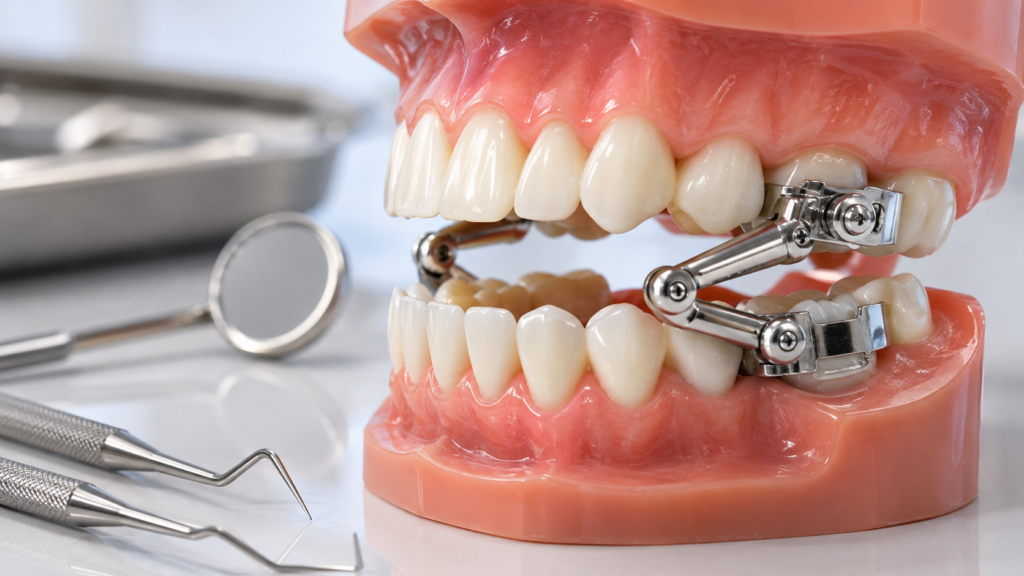

A herbst appliance is a fixed orthodontic device that helps correct certain bite problems by positioning the lower jaw farther forward. Orthodontists commonly recommend it for growing children and teenagers whose upper teeth sit too far ahead of their lower teeth, a condition often associated with Class II malocclusion.
Unlike removable orthodontic devices, a traditional herbst appliance stays attached to the teeth and uses metal arms to guide the jaw into a forward position. This allows it to work throughout the day without depending on the patient remembering to wear it. However, it is not suitable for everyone, and treatment decisions depend on the patient’s bite, dental development, and individual needs.
Understanding how the device works, how long treatment takes, and how to care for it can help patients and parents prepare for orthodontic treatment.
What Is a Herbst Appliance?
A herbst appliance is an orthodontic device designed to improve the relationship between the upper and lower jaws. It is most commonly used when the lower jaw sits relatively far back compared with the upper jaw, contributing to an uneven bite or prominent upper front teeth.
The device generally consists of metal bands, crowns, or other attachments connected to the upper and lower back teeth. Telescoping metal rods and tubes on either side link these attachments and help maintain the lower jaw in a forward position.
Although designs vary between orthodontic practices, the purpose remains similar: to improve the relationship between the jaws and help the teeth meet more appropriately.
Orthodontists most frequently use this treatment for children and teenagers who are still growing. Adults may sometimes be considered for particular applications, but treatment options differ because jaw growth is complete.
How Does a Herbst Appliance Work?
The device works by maintaining the lower jaw in a more forward position when the mouth opens and closes. The metal mechanisms connect the upper and lower dental attachments, guiding jaw movement and applying sustained forces.
Over time, this positioning can help improve the bite relationship. The overall correction may involve changes in tooth position, jaw-related adaptation, and growth-related effects in younger patients. The exact contribution of each factor varies, so the device should not be described as simply making the lower jaw grow in every patient.
A herbst appliance is often used as part of a wider orthodontic treatment plan rather than as a complete solution on its own.
For example, an orthodontist may recommend the device first to address a significant bite discrepancy and then use braces to align individual teeth. In other cases, both treatments may be provided during overlapping stages.
The orthodontist assesses progress during follow-up appointments and determines when the appliance can be removed or when additional treatment is necessary.
Who Needs a Herbst Appliance?
The device is primarily used to treat certain forms of Class II malocclusion. This means the upper and lower teeth or jaws have a relationship that differs from the desired alignment.
A patient may be considered for treatment when the lower jaw is positioned relatively far back, the upper front teeth protrude noticeably, or the bite relationship creates functional or orthodontic concerns.
Children and teenagers are frequent candidates because their jaws are still developing. Treatment during growth may offer opportunities to influence the developing bite, although results depend on individual circumstances.
Not everyone with an overbite needs this device. An overbite can involve different combinations of tooth position and jaw structure, and those differences influence the appropriate treatment.
An orthodontist will usually examine the teeth and bite, assess jaw relationships, review dental records and imaging when indicated, and consider the patient’s growth stage before recommending a treatment plan.
Benefits of a Herbst Appliance
One major advantage is that the device remains fixed in place. Patients do not have to remember to insert it after meals or wear it for a prescribed number of hours each day, as they would with many removable functional appliances.
A herbst appliance can also be used alongside braces, allowing an orthodontist to address jaw relationships and tooth alignment within a coordinated treatment plan.
Other potential benefits include improved alignment between the upper and lower teeth, reduced prominence of the upper front teeth in appropriate cases, and less reliance on patient compliance with daily appliance wear.
The appliance is contained inside the mouth, so it does not require the external straps associated with traditional headgear.
However, these benefits are not guaranteed. Treatment effectiveness depends on the severity and cause of the bite problem, the patient’s stage of development, appliance design, and the broader orthodontic plan. Fixed appliances also require careful cleaning and regular professional monitoring.
What Are the Disadvantages and Possible Side Effects?
Although the device can be useful, patients should understand its practical limitations before treatment begins.
During the initial adjustment period, the mouth may feel crowded or awkward. Some patients experience tenderness around the teeth, jaw muscle soreness, cheek irritation, or difficulty chewing comfortably.
Speech may also feel different temporarily as the mouth adapts to the hardware. These effects often improve with time, but persistent or worsening symptoms should be discussed with the orthodontist.
Another disadvantage is the need to avoid certain foods. Hard, sticky, and chewy items can damage the appliance or cause its components to loosen. Cleaning around the attachments may also take more effort than ordinary brushing.
Mechanical problems can occur, including loose attachments, damaged bands, or disconnected rods and tubes. A herbst appliance should never be bent, forced, or independently modified to solve these problems.
The best way to manage these risks is to follow the orthodontist’s instructions, maintain good oral hygiene, and attend scheduled appointments.
How Long Do You Wear a Herbst Appliance?
Treatment duration varies according to the patient’s bite, growth stage, response to treatment, and the orthodontist’s objectives.
Many patients wear the device for approximately 9 to 12 months, although some treatment plans require a shorter or longer period. Cleveland Clinic notes that about a year is common for many children, while emphasizing that individual treatment times differ.
A herbst appliance may be used before braces, at the same time as braces, or as one phase of a longer treatment programme. Removing the device does not necessarily mean orthodontic treatment has finished.
Braces or other appliances may still be needed to refine tooth positions and improve the final bite. Your orthodontist will monitor progress and decide when the appliance has achieved its intended purpose.
Patients should not compare their progress directly with someone else’s treatment timeline. Two people with apparently similar overbites may have different underlying dental and skeletal characteristics.
What to Expect When Getting a Herbst Appliance
The fitting process is usually arranged through an orthodontic practice. Depending on the design and the patient’s dental condition, the orthodontist may prepare the teeth and create space around the back teeth before attaching the device.
Once fitted, the metal arms may make the jaw feel as though it is being held in an unfamiliar position. The back teeth may not meet in the same way as before, and eating can initially feel uncomfortable.
For the first few days, softer foods are often easier to manage. Cutting meals into small pieces and chewing slowly can also help while the mouth adapts.
A herbst appliance usually becomes easier to tolerate as the patient gets used to its position and movement. The adjustment period differs from person to person, so patients should follow their own orthodontist’s guidance rather than expect discomfort to disappear on a specific day.
If the device causes significant pain, prevents normal eating, or develops a mechanical problem, contact the treating practice.
How to Eat and Care for a Herbst Appliance
Good daily care protects the teeth and helps reduce the risk of problems during treatment.
Foods to avoid
Patients are generally advised to avoid very hard, sticky, or chewy foods. Examples include hard sweets, chewing gum, toffee, ice, popcorn, and tough chewy snacks.
Raw fruits and vegetables do not necessarily need to be eliminated, but cutting them into smaller pieces or thin slices can make them easier to eat and reduce pressure on the device.
Soft foods such as eggs, yoghurt, pasta, soft-cooked vegetables, and tender fish may be more comfortable during the early adjustment period.
Cleaning your teeth
Brush at least twice daily with fluoride toothpaste, paying particular attention to the areas around the metal attachments and bands. Food can collect around these components, making thorough cleaning especially important.
Floss daily using a method recommended by your dental professional. Interdental brushes may help clean around difficult-to-reach areas, while a water flosser can be an additional aid if appropriate.
A herbst appliance does not replace routine dental care. Regular dental check-ups and orthodontic appointments help monitor tooth health, gum condition, and the performance of the device.
What if the appliance breaks?
If a rod becomes disconnected, a band loosens, or a component breaks, contact your orthodontist for instructions. Do not pull on the metal arms or attempt to reshape the mechanism.
If your orthodontist has shown you how to reconnect a particular component safely, follow those specific instructions. Otherwise, seek professional guidance rather than forcing the device back into place.
Herbst Appliance vs. Other Orthodontic Treatments
The best treatment depends on the reason for the bite problem, the patient’s age, and the amount of correction required.
| Treatment | Main characteristic | Important consideration |
|---|---|---|
| Herbst appliance | Fixed device that guides the lower jaw forward | Requires careful cleaning and appliance monitoring |
| Twin Block appliance | Usually removable functional appliance with upper and lower components | Depends on wearing it as instructed |
| Braces | Move teeth into improved alignment | May be used with a jaw-correcting appliance |
| Orthodontic headgear | Uses external components to apply orthodontic forces | Requires consistent use according to the prescribed plan |
A herbst appliance may be preferable when continuous wear is important and a suitable fixed device can address the patient’s bite problem. A removable appliance may be appropriate for other patients, while braces primarily address tooth alignment.
These options are not interchangeable in every case. An orthodontist can explain the likely benefits, limitations, and treatment sequence for each option.
How Much Does a Herbst Appliance Cost?
There is no single price that applies to every patient. The cost depends on the country, orthodontic practice, appliance design, complexity of the bite problem, and whether the quoted fee includes braces and follow-up care.
Some treatment plans combine the device with a wider course of orthodontics, while others charge for different stages separately. Insurance coverage or public dental arrangements may also affect out-of-pocket costs.
Before starting treatment, ask the orthodontist for a written estimate that explains what is included, how repairs are handled, and whether additional treatment is expected after removal.
It is better to compare complete treatment plans than to choose a provider based on the appliance price alone. The suitability of the treatment and the clinician’s assessment are more important than finding the lowest initial fee.
Conclusion
A herbst appliance is a useful orthodontic option for selected patients who need correction of certain bite problems, particularly those involving a lower jaw positioned relatively far back. Its fixed design provides continuous guidance without relying on daily insertion and removal.
Successful treatment involves more than wearing the device. Careful oral hygiene, sensible food choices, regular orthodontic visits, and prompt attention to damaged components all matter.
If you or your child has an overbite or another bite concern, consult a qualified orthodontist to determine whether this treatment is appropriate. An individual assessment is the best way to understand expected results, treatment duration, costs, and whether braces or another approach may be needed.
(FAQs)
Does a herbst appliance hurt?
Some tenderness, pressure, or cheek irritation is common after fitting. These symptoms often improve as the mouth adapts. Persistent, severe, or worsening pain should be assessed by the treating orthodontist.
Can you eat normally with a herbst appliance?
Most patients gradually return to a more comfortable eating routine. Soft foods are often helpful initially, while hard, sticky, and chewy foods should generally be avoided to protect the device.
Is a herbst appliance better than braces?
They serve different purposes. A Herbst device helps address certain jaw and bite relationships, while braces primarily move teeth into better alignment. Many patients need both as part of a coordinated treatment plan.
Can adults get a herbst appliance?
Yes, selected adults may be considered for particular applications, but it is most commonly used in growing children and teenagers. Since adults have finished growing, the potential effects and alternative treatments differ.
How do you know if a herbst appliance is working?
Your orthodontist monitors changes in the bite, tooth relationships, and appliance function during regular visits. Visible changes alone are not enough to determine whether treatment is progressing as planned.
What happens after the appliance is removed?
Some patients proceed to braces or another orthodontic treatment phase to refine tooth alignment and improve the final bite. The next step depends on the results achieved and the original treatment plan.