
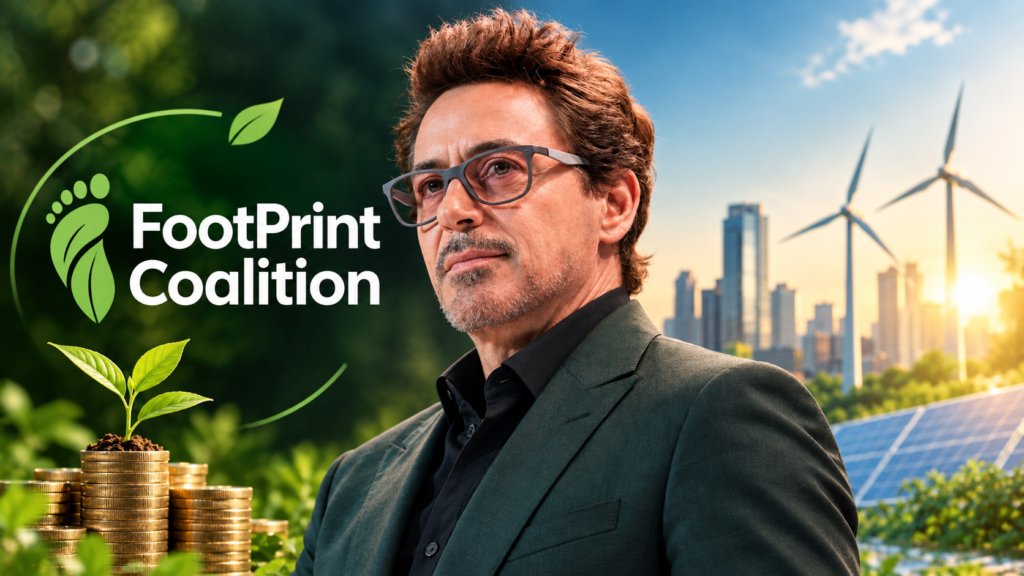

Robert Downey Jr. turned his global celebrity platform into something considerably more ambitious than a conventional environmental campaign. FootPrint Coalition combines venture investing, media, scientific support and philanthropy to accelerate technologies intended to address climate change and environmental degradation. Launched publicly in 2019, the organization initially focused on the idea that technologies such as robotics and advanced science could help restore the planet.
The model has since developed into a broader ecosystem. Its investment arm, FootPrint Coalition Ventures, backs companies working across energy, transportation, food and agriculture, buildings, materials and other climate-related markets. At the same time, the wider organization uses storytelling and grants to support environmental innovation.
That combination is what makes the business interesting: it is not simply a celebrity-backed venture fund, nor is it solely a nonprofit environmental project.
Table of Contents
ToggleQuick Facts
| Detail | Information |
|---|---|
| Organisation | FootPrint Coalition |
| Founded | 2019 |
| Founder | Robert Downey Jr. and founding team |
| Headquarters | Los Angeles, California, according to its LinkedIn company profile |
| Industry | Climate technology, venture capital, media and environmental impact |
| Investment arm | FootPrint Coalition Ventures |
| Business model | Venture investment, media/content and philanthropic initiatives |
| Investment focus | Climate mitigation, adaptation, sustainable technology and planetary restoration |
| Ownership | Privately held |
| Public trading status | Not publicly traded |
| Publicly reported portfolio | More than 20 companies; a 2023 impact-report document reported 23 investments |
The organization describes its work around three main levers: media advocacy, venture capital investment, and nonprofit initiatives.
What Is FootPrint Coalition?
FootPrint Coalition is an environmental investment and media organization founded by Robert Downey Jr. and collaborators to help scale technologies that address climate and environmental challenges. Its approach is deliberately broader than simply writing venture cheques: the organization aims to use capital, storytelling and scientific support together.
The original public launch came in 2019, when Downey announced the initiative at Amazon’s re: MARS conference. At that stage, the concept centered heavily on advanced technologies, including robotics and nanotechnology, as potential tools for environmental restoration.
The strategy became more commercially defined in January 2021 with the launch of FootPrint Coalition Ventures. The venture operation was designed to invest in sustainable technology companies at different stages of development, while also giving outside investors a route into the funds.
This distinction matters. FootPrint Coalition is the broader platform; FootPrint Coalition Ventures is its venture-capital component.
How the FootPrint Coalition Business Model Works
The organization’s business model is best understood as a combination of capital allocation and attention allocation.
On the investment side, FootPrint Coalition Ventures seeks companies developing technologies that can change established industries. Its published investment process describes a pipeline that can originate partly through the organization’s media and publishing activities. The investment team then evaluates companies and looks for opportunities around technical breakthroughs, improving unit economics, commercial milestones, product development and policy changes.
The second component is media. The organization publishes stories about climate technologies and portfolio companies, creating an audience around subjects that can otherwise be technically difficult or commercially obscure. Its 2021 review explicitly described storytelling as a way to generate awareness for portfolio companies and help attract investors and entrepreneurs.
The third component is philanthropy. Grants have supported areas including cellular agriculture, microplastics, conservation technology, reef temperatures, water-from-air research, wetland creation, and biodiversity projects.
That creates a flywheel: investment can provide capital to a young company, media can increase its visibility, and philanthropic activity can support science or environmental work that may sit outside a conventional venture-capital return model.
Who Founded and Leads FootPrint Coalition?
Robert Downey Jr. is the public face and chairman associated with the initiative, but the organization was not designed as a one-person investment operation.
FootPrint Coalition’s materials identify Robert Downey Jr., Susan Downey, Steve Levin, Rachel Kropa and Jonathan Schulhof among its founders.
For the venture operation, Jonathan Schulhof and Steve Levin were identified as managing leaders when FootPrint Coalition Ventures launched. Schulhof brought technology and investment experience, while Levin had worked with Downey on Team Downey and Downey Ventures.
This structure is important to understanding the business. Downey supplies an unusually powerful combination of public reach, entertainment expertise and personal capital, while investment professionals handle much of the specialist venture work.
The organization is privately held and not publicly traded. Its LinkedIn profile identifies Los Angeles as its headquarters and describes the organization as privately held.
What Companies Has FootPrint Coalition Invested In?
The portfolio spans considerably more than renewable electricity. The organization’s investment pages list companies working across food, agriculture, energy, buildings, transportation, materials, consumer products, and environmental technology.
Better-known examples include Commonwealth Fusion Systems, ClimateAI, TurnTide, RWDC, Span, Sealed, Whisper Aero, Wildtype, Ÿnsect, Zero Acre Farms, Kindred Motorworks, and MyForest Foods.
The diversity is intentional. Climate technology is not a single market, and decarbonization can involve everything from electricity generation and motors to food production and home energy efficiency.
For example, Sealed focuses on financing home-efficiency improvements, including insulation and heating and cooling upgrades. Its model is designed around paying upfront costs and recovering its investment as homes save energy.
RWDC, meanwhile, works on PHA, a bio-based alternative to conventional plastic. Its technology aims to provide a material that functions similarly to plastic while addressing concerns about persistent plastic pollution.
In mobility, FootPrint Coalition has highlighted companies such as Kindred Motorworks, TurnTide, Lyten and Whisper Aero. These businesses address different parts of the transportation and electrification ecosystem rather than competing for the same customer.
Investment Strategy, Funding and Financial Transparency
FootPrint Coalition Ventures was launched in 2021 with rolling venture funds designed to invest in sustainable technology. One fund targeted seed and Series A opportunities, while another focused on later-stage investments. The organization also sought outside participation through a rolling-fund structure administered through AngelList.
Its early strategy included backing companies alongside established venture investors. In its 2021 review, FootPrint Coalition said it had invested in 16 sustainable technology companies and co-invested alongside firms including Breakthrough Energy, Menlo Ventures, Viking Global and Coatue.
A later impact-report document stated that the venture funds had invested in 23 companies, with one investment still unannounced at the time. The portfolio was concentrated mainly in climate mitigation, particularly energy, transportation, homes and buildings, and food and agriculture.
A key limitation for anyone researching FootPrint Coalition’s financial performance is that it is a private investment organization, not a public corporation required to publish quarterly earnings, revenue statements, or a market valuation. Publicly available materials therefore do not provide a reliable basis for stating a current overall valuation, annual revenue or profit figure.
Claims online about the organization’s “worth” should consequently be treated carefully unless tied to a specific documented fund, investment or transaction.
Market Position and Competitive Landscape
FootPrint Coalition operates in a crowded but expanding climate-investment ecosystem. It overlaps with specialist climate venture funds, impact investors, corporate venture arms and celebrity-backed sustainability initiatives. Still, its combination of investing and entertainment-driven media gives it a different positioning.
Its strongest potential advantage is attention. Climate startups often need more than financing: they need customers, credibility, talent and follow-on investors. FootPrint Coalition’s investment materials explicitly position storytelling and public exposure as part of the value it can provide portfolio companies.
The approach also has limitations. Celebrity association can generate initial visibility, but venture investing ultimately depends on technology, economics, execution and market adoption. A strong public profile cannot guarantee commercial success, particularly in capital-intensive areas such as fusion energy, advanced materials or aviation.
The broader climate-investment market is also highly competitive. Startups may have access to specialist funds, government programs and major investors with significantly larger pools of capital. FootPrint Coalition therefore needs to differentiate through investment judgment, network and media reach rather than simply competing on cheque size.
Current Position and Future Outlook
Publicly available information suggests that FootPrint Coalition’s portfolio and climate-media activities remain centered on technologies intended to reshape energy, transportation, food, buildings and materials. Its website continues to showcase portfolio companies and climate-related reporting, although the most recent prominently dated stories on its site are from 2024.
That means readers should distinguish between the organization’s established strategy and any claims about a specific 2025 or 2026 investment that are not supported by a recent primary announcement.
The long-term thesis is relatively straightforward: technologies that make low-carbon products and systems cheaper, better or easier to adopt can become large businesses while also reducing environmental impact. FootPrint Coalition is attempting to participate in that transition before those technologies reach full commercial maturity.
Its future success will depend on the same factors facing other climate investors: whether portfolio companies achieve technological breakthroughs, reach commercial scale, attract follow-on capital and produce competitive returns. The model’s media component may provide an additional advantage, but it does not remove the fundamental risks of venture investing.
Conclusion
FootPrint Coalition is best understood as a hybrid climate platform rather than simply Robert Downey Jr.’s personal investment fund. Since its 2019 launch, it has developed a model that combines venture capital, media advocacy, and philanthropic support for environmental and scientific initiatives.
Its venture portfolio illustrates the breadth of the climate economy, covering energy, mobility, food, agriculture, buildings, materials and emerging technologies. The organization’s distinctive proposition is that capital and storytelling can work together: funding can help companies grow, while media exposure can help them attract customers, talent and additional investors.
The financial picture is less transparent than it would be for a public company, and there is no reliable public figure for FootPrint Coalition’s current valuation or consolidated revenue. Still, its strategy offers an interesting case study in how celebrity influence, venture investing, and environmental advocacy can be combined into a single business ecosystem.
For more business news, company profiles, financial insights, and latest updates, visit DailyInfoz.co.uk.
(FAQs)
What does FootPrint Coalition do?
FootPrint Coalition supports environmental innovation through venture investing, media and philanthropic initiatives. Its work focuses on technologies intended to address climate mitigation, adaptation, sustainability and planetary restoration.
Who founded FootPrint Coalition?
FootPrint Coalition was founded by Robert Downey Jr., Susan Downey, Steve Levin, Rachel Kropa, and Jonathan Schulhof, according to the organization’s own impact materials. Robert Downey Jr. serves as its most prominent public figure and chairman.
How does FootPrint Coalition make money?
The investment side operates through venture funds that invest in private companies. The broader organization also operates media and philanthropic programs. Because FootPrint Coalition is private, a consolidated public breakdown of its revenue and profit is not available.
Is FootPrint Coalition publicly traded?
No. FootPrint Coalition is a privately held organization and does not have publicly traded shares. It conducts its investment activities through private venture structures rather than a stock-market listing.
What types of companies does FootPrint Coalition invest in?
Its portfolio includes businesses working in energy, transportation, food and agriculture, home and buildings, industrial technology, materials and waste. Examples listed by FootPrint Coalition include Commonwealth Fusion Systems, ClimateAI, RWDC, Span, Sealed, Whisper Aero, and Zero Acre Farms.
How much is FootPrint Coalition worth?
There is no reliable, publicly confirmed current valuation for FootPrint Coalition as a whole. Since it is privately held and operates investment funds rather than a publicly traded corporation, figures presented online as its total “worth” should be treated as estimates unless supported by a specific primary source.