
Fontlu is a name associated with online font discovery, typography tools, and creative design resources. People searching for Fontlu may want to find stylish fonts, preview text in different typefaces, download fonts for graphic design, or understand whether a particular website is safe to use. However, there is an important distinction: the name appears across multiple websites, and the available evidence does not establish one universally recognized platform with a single, verified set of features.
Understanding Fontlu starts with identifying the specific website or service behind the name. Some websites describe font browsing and text previews, while others publish broader guides about typography and digital creativity. Rather than assuming that every advertised feature belongs to the same service, users should evaluate the actual tool they intend to use. This approach helps designers choose suitable typefaces, understand licensing restrictions, and avoid wasting time on tools that do not meet their requirements.
What Is Fontlu?
Fontlu is a typography-related name that appears in online resources focused on fonts, lettering, and creative design. Depending on the website, visitors may encounter font-related articles, text preview interfaces, or descriptions of services intended to help users discover typefaces.
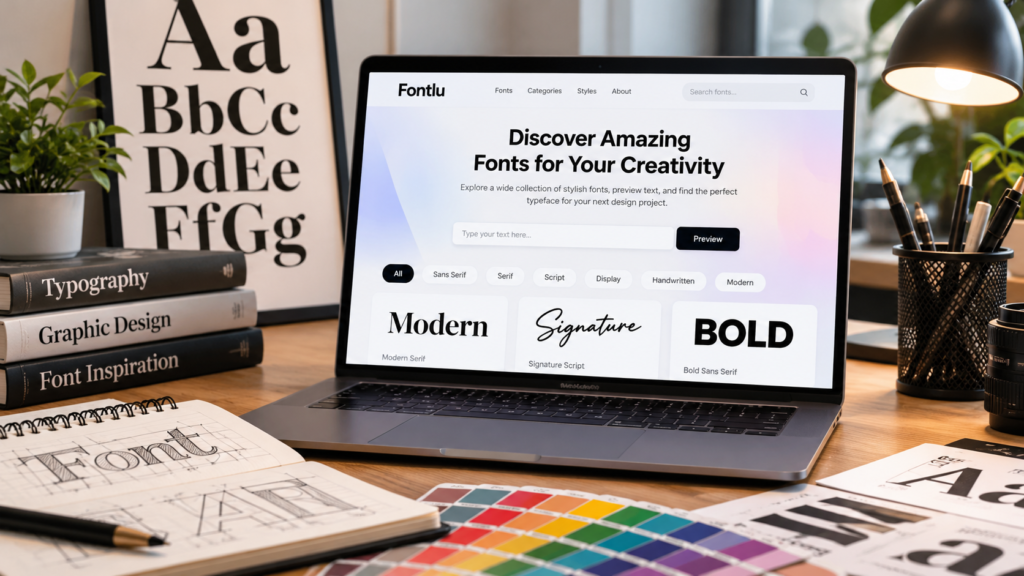
One example is Fontlu.net, which presents a font creator interface where visitors can enter text, select a font, adjust its size, and preview the result. Its website also describes Fontlu as a resource for free and premium fonts. These publicly presented features should be distinguished from broader claims about advanced font management or professional design software.
The name itself does not establish that a particular website is an official font company, a downloadable application, or a complete typography management system. Details such as ownership, pricing, supported features, and licensing need to be checked on the specific website.
For designers, the most practical way to understand Fontlu is to examine what the chosen resource actually provides. Can it preview a typeface? Does it offer downloadable font files? Does it explain commercial licensing? Those concrete capabilities matter more than a platform’s marketing description.
Why Typography Matters in Digital Design
Typography is the visual presentation of written language. It includes the selection of typefaces, font sizes, spacing, line height, alignment, and the relationship between different text elements.
The right typography makes information easier to read and helps establish a recognizable visual identity. A clothing brand, for example, might use a bold display typeface for its logo, a clean sans-serif font for product descriptions, and a distinctive script font for selected decorative elements.
Fontlu-related resources can be useful when exploring these creative possibilities, provided the particular website offers relevant preview or discovery tools.
Typography affects several important aspects of design. Readability determines how easily someone can understand text. Visual hierarchy helps readers distinguish headings from supporting information. Brand consistency ensures that logos, advertisements, product labels, and websites communicate a coherent identity.
A typeface that looks attractive in a short headline may be difficult to read in a long paragraph. Similarly, a decorative font that works for a clothing logo may be unsuitable for a product description. Testing fonts in their intended context is therefore more useful than choosing a style based on appearance alone.
Key Features to Look for in a Font Resource
The features available depend on the individual service. When evaluating Fontlu or another online typography resource, focus on practical functions that support your workflow.
Font Preview and Text Customization
A font preview allows users to see how a typeface renders particular words before committing to it. This is especially useful for logos, garment prints, website headings, social media graphics, and promotional materials.
If the selected Fontlu website provides a text preview, enter the actual wording you intend to use. Test uppercase and lowercase letters, numerals, punctuation, and longer phrases. Different combinations can reveal spacing problems or letter shapes that are difficult to recognize.
Adjusting the preview size can also help you judge whether a font remains legible at the final print or display size. A typeface that looks excellent on a large screen may lose clarity when printed on a small clothing label.
Font Discovery and Style Selection
Font discovery involves finding typefaces that suit a particular visual purpose. Common categories include serif, sans-serif, script, monospace, and display fonts.
Serif fonts often feature small finishing strokes at the ends of letterforms. Sans-serif fonts lack these strokes and are frequently used in contemporary interfaces and branding. Script fonts imitate connected or handwritten lettering, while display fonts are designed primarily for distinctive, attention-grabbing applications.
A Fontlu-related website may help users explore some of these styles, but the available categories should be verified directly rather than assumed.
Download Options and File Compatibility
If a resource offers font downloads, check the available file formats before downloading. Three common formats are TrueType Font (TTF), OpenType Font (OTF), and Web Open Font Format (WOFF).
TTF and OTF files are commonly used for desktop typography, although compatibility and supported features vary by application. WOFF and WOFF2 are formats intended primarily for web fonts.
The correct format depends on the software and project. A font used in a printed clothing design has different implementation requirements from a font embedded in a website.
Licensing Information
Licensing is one of the most important considerations when selecting fonts for professional work. A font being available for free download does not automatically mean it can be used commercially.
Some typefaces permit personal projects but require payment or additional permission for business use. Others use open-source licenses with specific conditions. Certain licenses may also distinguish between desktop, web, application, and other uses.
Before using a Fontlu-discovered typeface on products for sale, review the original license and retain a copy of the applicable terms. If the website does not provide clear licensing information, locate the font creator’s original distribution page.
How to Use Fontlu for a Design Project
The process depends on the specific website, but a practical font-selection workflow can be applied to most typography resources.
First, identify the purpose of the design. A children’s clothing logo, a luxury fashion label, a website heading, and a long editorial article each have different typographic requirements. Decide whether you need readability, personality, elegance, boldness, or a combination of these qualities.
Next, open the particular Fontlu resource you intend to use and inspect its available features. If a font preview tool is present, enter your actual text rather than relying solely on sample lettering. Compare several typefaces at realistic sizes and pay attention to the shape of individual characters.
Once you find a suitable font, check its availability and license. If downloadable files are offered, obtain them from a source you trust and install or embed them according to the software’s requirements.
Finally, test the font in the finished design. For a garment print, check letter spacing, fine details, and legibility at the intended dimensions. For a website, examine the font on desktop and mobile screens and ensure that the text remains readable.
This workflow makes Fontlu-related resources part of a broader design process rather than treating font selection as a purely decorative decision.
Fontlu vs. Google Fonts and Other Typography Tools
Different typography resources serve different purposes. The best choice depends on whether you need font discovery, website integration, desktop font management, or original typeface creation.
Google Fonts is an established resource for discovering and using open-source fonts. Its catalog and web-font integration make it particularly useful for websites and digital products. Its official documentation also provides information about font families and implementation.
Fontlu, by comparison, is a less clearly defined name associated with several online resources. Some sites present font preview and discovery features, but claims about a unified professional platform should not be accepted without independent confirmation.
Dedicated font-management applications focus on organizing, activating, and managing installed typefaces. Professional font-editing applications go further by allowing users to create or modify glyphs and develop original fonts. A basic online preview tool does not necessarily provide either capability.
The distinction matters because finding a font, managing a font collection, and designing a new font are three separate tasks. A user looking for decorative text may need only a preview tool, while a developer building a website may benefit more from Google Fonts or another established web-font provider.
Is Fontlu Safe to Use?
The safety of Fontlu cannot be determined from its name alone. Multiple websites use the term, and a reliable assessment requires identifying the exact domain, examining its practices, and evaluating the files or services it offers.
Before using a font website, check that the domain is spelled correctly, its contact and privacy information are available, and its licensing terms are understandable. Avoid installing unknown executables or browser extensions merely to access font files.
Font files themselves should come from trustworthy sources. Scan downloaded files using reputable security software and avoid websites that disguise unrelated downloads as font packages.
Also consider privacy when using online preview tools. If you enter unpublished brand names, client information, or confidential campaign text, review the site’s privacy policy before submitting that material.
These precautions do not mean that Fontlu is inherently unsafe. They reflect the need to evaluate each website on its own merits, particularly when its ownership and service details are not independently established.
Common Mistakes When Choosing Fonts
One frequent mistake is choosing a font because it looks attractive without checking whether it suits the project. Decorative lettering may work well in a logo but become difficult to read in a paragraph.
Another mistake is combining too many typefaces. Many designs can achieve a clear hierarchy with one or two complementary font families. Additional styles should serve a specific purpose rather than introduce unnecessary visual noise.
Ignoring licensing can create problems when a design moves from a personal experiment to a commercial product. Always verify the terms before using a typeface on clothing, packaging, advertisements, or client deliverables.
Finally, users should avoid assuming that every Fontlu-branded website offers the same functions. Confirm the exact service, available tools, download options, and terms before building a workflow around it.
Conclusion
Fontlu is best approached as a typography-related name rather than a single, fully verified software platform. Online resources associated with the name may help users explore font styles, preview lettering, or find typefaces for creative projects, but their features and terms vary.
The most reliable approach is to identify the exact website, test its available functionality, verify font licensing, and confirm compatibility with your intended design workflow. For designers, developers, and content creators, those practical checks matter more than broad marketing claims. A suitable font should not only look right but also remain readable, legally usable, and appropriate for the final project.
Frequently Asked Questions
What is Fontlu used for?
Fontlu is a name associated with online font resources and typography-related tools. Depending on the website, users may find font information, text previews, or font discovery features. The precise functions depend on the specific service.
Is Fontlu free to use?
Pricing cannot be established for every website using the name. Fontlu.net describes a resource featuring free and premium fonts, but users should check the current terms of the particular service before assuming that downloads or advanced features are free.
Can I use Fontlu fonts for commercial projects?
Potentially, but commercial permission depends on the individual typeface and its license. Verify the original licensing terms before using any downloaded font on products for sale, business websites, or client designs.
Can Fontlu help with clothing and logo design?
Font-related resources can support clothing and logo design by helping users explore lettering styles and evaluate how words appear in different typefaces. The usefulness of a particular Fontlu website depends on whether it provides the necessary preview or download functionality.
Is Fontlu an alternative to Google Fonts?
It may serve as an alternative for certain font-discovery tasks, depending on the specific resource. Google Fonts is an established font library with documented web integration, while Fontlu refers to multiple less clearly defined resources. They should not be assumed to offer equivalent features.
Do I need to install software to use Fontlu?
Not necessarily. Some font-related websites offer browser-based previews, while using a downloaded font in desktop design software generally requires installing it or following the application’s supported font-loading process. Check the requirements of the specific service and software.