
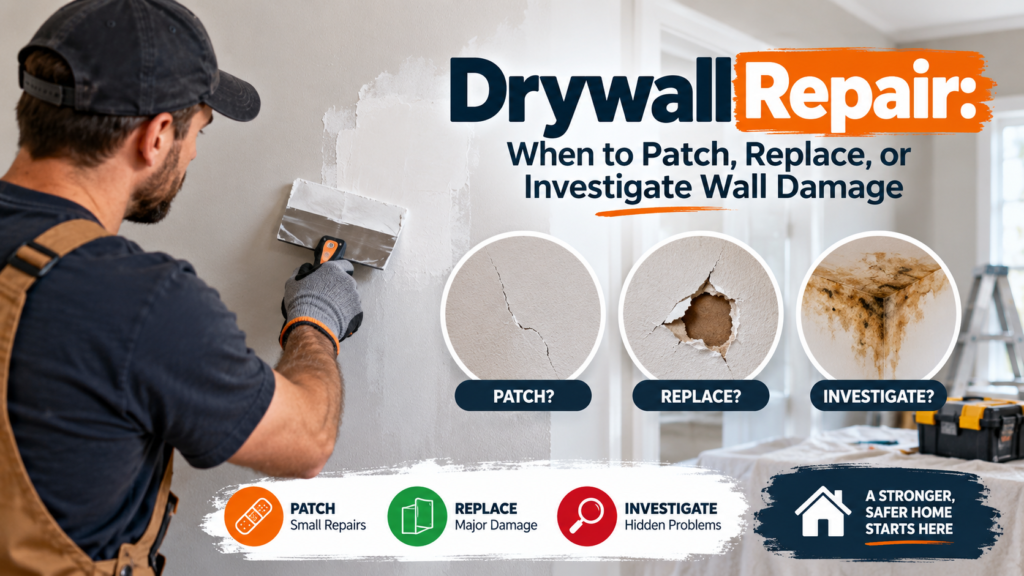

A small crack near a doorway might need a straightforward fix. A soft, stained section of wall could tell a very different story. That distinction is important because not every drywall problem should be treated in the same way.
Effective drywall repair starts with identifying what happened, determining how much material is affected, and selecting a repair method suited to the damage. Taking this approach can produce a cleaner finish while reducing the chance of the same problem appearing again.
Start With the Type of Damage
Before repairing a wall, look closely at the affected area.
Tiny nail and screw holes are generally cosmetic. Dents and shallow gouges may also affect only the surface. Larger impact holes, damaged corners, separating joints, and moisture-related deterioration usually require more preparation.
Cracks deserve particular attention because their location and pattern can provide useful clues.
Cosmetic Cracks Versus Recurring Cracks
A narrow crack may develop as materials expand, contract, or settle. Repairing it can often restore the surface.
However, a crack that repeatedly returns after being repaired deserves closer investigation. Simply applying more compound may hide it temporarily without addressing the reason it keeps appearing.
Monitoring recurring damage can help homeowners determine whether the problem is limited to drywall or connected to movement elsewhere.
When Is Patching Appropriate?
Patching works well when damage is localized and the surrounding drywall remains firm.
Small imperfections can often be filled and feathered outward so that the repaired section blends into the existing surface. Medium-sized holes may require reinforcement or a fitted piece of drywall.
Preparation makes a major difference. Loose material needs to be removed, edges should be stable, and the patch must have adequate support.
Why Sanding Matters
Sanding may seem like a simple finishing step, but it strongly influences the final appearance.
Too little sanding can leave raised edges and ridges. Excessive sanding can damage surrounding surfaces or expose tape beneath the compound.
The goal is a gradual transition that becomes difficult to identify once the wall is primed and painted.
When Should Drywall Be Replaced?
Not every damaged section should be filled.
Replacement may be appropriate when drywall is badly broken, extensively deteriorated, warped, or weakened by moisture. Removing the compromised material creates an opportunity to install a sound replacement section instead of attempting to preserve an unstable surface.
The surrounding area should also be checked before new material is installed.
For homeowners evaluating more substantial wall damage, consulting drywall repair specialists in the area can provide useful guidance about whether patching or partial replacement makes more sense.
Moisture Damage Requires Extra Attention
Water stains should not automatically be treated as ordinary cosmetic marks.
Moisture can originate from plumbing, roofing, exterior openings, condensation, or other sources. Before damaged drywall is closed or refinished, the moisture source should be identified and corrected.
Look Beyond the Visible Stain
The visible mark may not represent the full affected area. Drywall that feels soft, swollen, crumbly, or distorted may have been exposed to more moisture than the surface initially suggests.
Correcting the source first helps protect the repaired area from recurring damage.
Achieving a Consistent Finish
Once the repair itself is complete, attention turns to appearance.
Joint compound should be smooth, edges should be properly feathered, and dust should be removed before finishing. Appropriate preparation before painting can also help prevent repaired sections from absorbing paint differently from surrounding areas.
Existing wall texture matters as well. Smooth walls require careful finishing because even minor imperfections may become visible under certain lighting conditions.
A Repair Is More Than a Patch
Good wall restoration is not simply about filling a hole. It involves understanding why the damage occurred, removing unstable material, rebuilding the surface where necessary, and finishing the repaired area carefully.
That process is particularly important when walls have several types of damage at once.
Conclusion
Choosing the correct approach to drywall damage begins with diagnosis. Small cosmetic imperfections may only require patching, while large, unstable, or moisture-affected areas can require partial replacement and further investigation.
Careful preparation, controlled application, sanding, and finishing ultimately determine how naturally a repaired area blends into the surrounding wall. When the cause of the damage receives as much attention as the visible defect, the finished repair is more likely to remain smooth, stable, and visually consistent.