
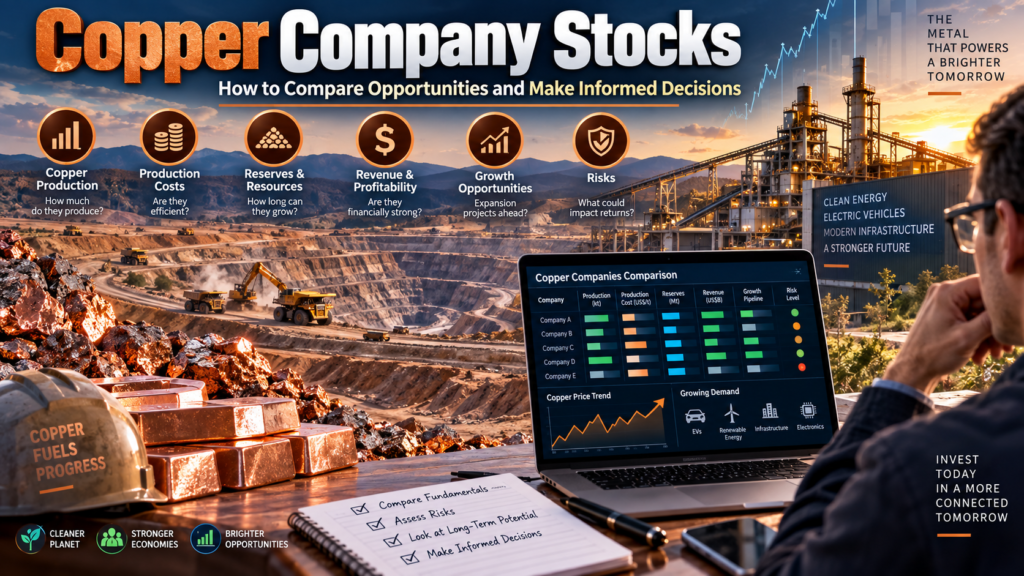

Copper is essential to many systems that support modern life. Electrical networks, buildings, transportation, industrial machinery, communications infrastructure, and energy systems all depend on conductive materials. As investment in electrification and infrastructure continues, copper has attracted growing attention from investors looking for exposure to long-term industrial trends.
However, comparing copper company stocks is not as simple as choosing businesses connected to the same commodity. Companies can differ dramatically in resource quality, development stage, operating costs, financial strength, geographic exposure, and management strategy.
A structured comparison can help investors identify these differences and understand which opportunities better match their objectives.
Start With the Company’s Core Assets
The first step is understanding what sits behind each investment opportunity.
Some businesses own producing mines, while others control projects that are still being explored, studied, permitted, financed, or developed. A company may also hold several assets at different stages.
Investors should identify which projects could contribute most significantly to future value.
Resource Size Is Only One Measure
A large copper resource may initially appear attractive. However, total size provides limited information when viewed alone.
Investors should also consider copper grade, deposit geometry, depth, processing characteristics, expected recovery, and potential mining method. These factors can influence the amount of material that must be mined and processed.
The economic quality of a resource can ultimately matter more than an impressive headline estimate.
Compare Companies at Similar Development Stages
Comparisons become more useful when investors examine businesses with similar characteristics.
A producing miner should not necessarily be assessed using the same criteria as an early-stage exploration opportunity. Producers generate operating data, while development-stage businesses depend more heavily on future milestones.
Understanding these differences can prevent misleading comparisons.
Producing Operations Require Cost Analysis
For a producing business, investors can examine output, operating expenses, capital requirements, mine life, and production consistency.
Cost control deserves particular attention because copper prices are determined by the broader market.
If expenses increase while copper prices decline, margins can come under pressure. Efficient operations may have greater flexibility during difficult commodity cycles.
Development Projects Depend on Execution
A development-stage project may have no current mine revenue, so investors need to focus on its pathway toward production.
Important questions include whether technical studies have been completed, what permits remain outstanding, how much capital development could require, and how management expects to finance construction.
Progress should be measured through tangible milestones rather than expectations alone.
Evaluate Financial Position and Funding Needs
Mining is capital intensive, making financial strength an important comparison point.
Investors should examine available cash, debt, spending commitments, and anticipated capital requirements. A business with an attractive resource may still encounter difficulties if it lacks sufficient funding to advance the project.
The balance sheet becomes particularly important during weak commodity markets.
Consider Future Share Dilution
Development and exploration often require ongoing funding.
When additional equity is issued, the number of shares outstanding can increase. This may reduce each existing shareholder’s proportional ownership unless the new capital creates sufficient additional value.
Investors should therefore examine historical financing activity and likely future capital requirements.
Debt can provide an alternative source of funding, but it introduces repayment obligations and financial risk.
Look Closely at Jurisdiction
Copper deposits cannot be relocated. The political, regulatory, and physical environment surrounding a mineral asset therefore matters significantly.
Investors should consider mining regulations, permitting procedures, taxation, infrastructure, environmental obligations, and political stability.
A strong resource located in a challenging jurisdiction may face a very different risk profile from a comparable resource in an established mining region.
Infrastructure Can Create an Advantage
Mining requires electricity, transportation, water, equipment access, and skilled workers.
A project close to established infrastructure may avoid some of the costs associated with building these systems from the beginning. Conversely, a remote project may require substantial additional investment before construction can proceed.
Investors should compare infrastructure requirements alongside geology and resource size.
Examine the Expected Mine Life
Mine life can provide insight into how long an operation may potentially produce copper based on current plans and resources.
Longer-life assets can offer extended exposure to copper markets, although they may also require significant ongoing capital expenditure.
Shorter-life operations may face greater pressure to replace depleted resources through exploration, expansion, or new projects.
Exploration Potential Adds Another Dimension
Some mining assets have opportunities for additional exploration around known mineralization.
Successful exploration could potentially extend mine life or increase the resource base. However, investors should remain cautious about assigning value to copper that has not yet been discovered or adequately defined.
Exploration upside is best viewed as potential rather than certainty.
Compare Management Teams by Results
Leadership can materially influence the success of a mining business.
Management teams make decisions about exploration, engineering, financing, construction, operations, and capital allocation. Poor decisions in any of these areas can weaken an otherwise promising project.
Investors should examine what management has actually accomplished rather than relying solely on projections.
Communication Quality Matters
Clear communication can make company evaluation easier.
Investors benefit when management explains project milestones, financial requirements, risks, and delays transparently. Frequent changes in targets without adequate explanation can deserve closer examination.
Consistency between stated objectives and actual results provides a practical way to assess execution.
Understand Sensitivity to Copper Prices
Companies can react differently to movements in the underlying commodity.
A producer with relatively high operating costs may experience substantial changes in profitability when copper prices move. A lower-cost operation could potentially have a greater buffer during downturns.
Development projects are also sensitive to commodity assumptions because expected copper prices can affect project economics and financing decisions.
Use Multiple Price Scenarios
Instead of trying to predict one exact future copper price, investors can evaluate several scenarios.
Consider what happens if copper prices strengthen, remain moderate, or weaken. Then examine how each business might perform under those environments.
This approach can reveal which opportunities depend heavily on optimistic assumptions.
Avoid Making Decisions Based on One Metric
No single measurement can determine whether an investment is attractive.
A large resource does not guarantee strong economics. Low projected costs do not eliminate permitting risk. A favorable jurisdiction cannot compensate for an uneconomic deposit.
Effective research combines multiple factors.
Investors can create a consistent framework covering resource quality, costs, mine life, development stage, balance-sheet strength, financing requirements, jurisdiction, infrastructure, and management execution.
Conclusion: Comparison Creates Better Perspective
Copper’s importance to electrical systems, construction, transportation, industrial development, and expanding infrastructure makes the sector worthy of investor attention. Yet companies exposed to copper can differ substantially even when they appear similar at first glance.
Investors should compare opportunities according to the quality of their assets, development progress, financial resources, cost structures, geographic conditions, funding requirements, and management performance.
Rather than searching for one perfect metric, a balanced comparison helps reveal both strengths and vulnerabilities.
Copper may offer an appealing long-term investment theme, but disciplined company-level research remains essential. Investors who compare opportunities systematically can make decisions based on underlying fundamentals rather than market enthusiasm alone, creating a clearer understanding of both potential rewards and risks.