
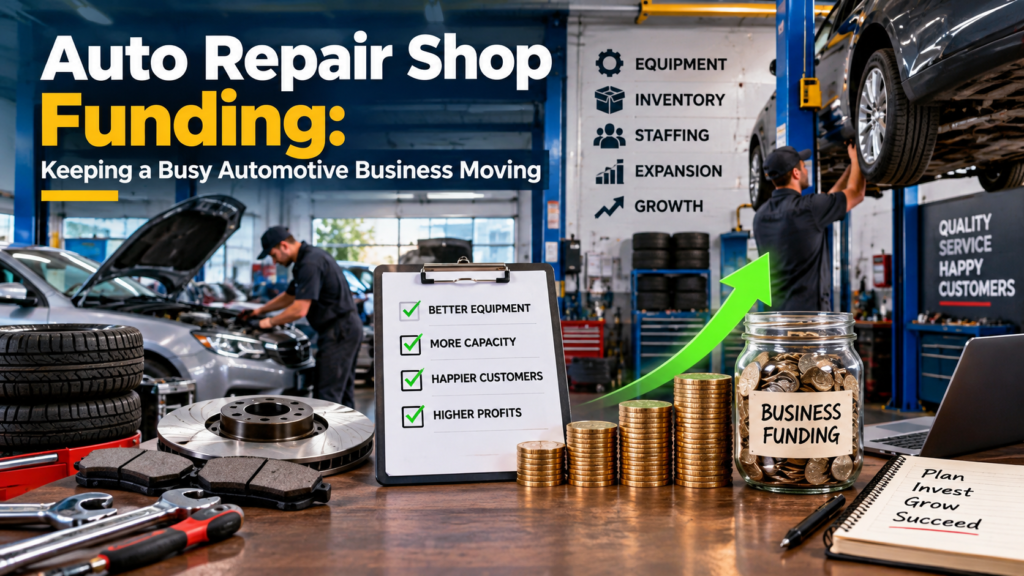

An auto repair business depends on far more than mechanical expertise. Shops must manage equipment, diagnostic technology, replacement parts, employee wages, facility expenses, and changing customer demand. When available cash cannot comfortably cover an urgent investment or expansion, auto repair shop funding can provide owners with another way to address business needs.
Knowing when additional capital could help is just as important as knowing how to use it.
Why Auto Repair Shops Experience Cash Flow Challenges
Repair shops can generate consistent revenue while still facing uneven cash flow.
Parts often need to be purchased before a customer pays the final invoice. Payroll and rent remain due regardless of how quickly customers authorize repairs.
Meanwhile, unexpected equipment failures can require immediate attention.
Modern Repair Work Requires Technology
Vehicles increasingly rely on electronic and computerized systems.
Repair businesses may need updated diagnostic tools, software, lifts, alignment equipment, tire machines, and other specialized resources to service different vehicles efficiently.
Falling behind technologically can restrict the types of jobs a shop can accept.
Signs a Shop May Need Additional Capital
Not every financial challenge requires outside funding. However, certain situations may indicate that additional working capital deserves consideration.
One sign is repeatedly delaying necessary equipment purchases because paying upfront would consume too much operating cash.
Another is turning away profitable work because the shop lacks sufficient tools, inventory, staff, or service capacity.
Equipment Replacement and Upgrades
Reliable equipment directly affects productivity.
If technicians regularly wait for outdated or malfunctioning equipment, the business may complete fewer jobs each day.
Auto repair shop funding may allow owners to upgrade essential tools without using the entire cash reserve at once.
Calculate the Business Impact
Before purchasing equipment, estimate how it could improve operations.
Will a new machine allow the shop to offer an additional service? Could upgraded diagnostics reduce the time technicians spend identifying problems? Will replacement equipment reduce downtime?
Connecting the investment to measurable outcomes helps determine whether funding makes financial sense.
Hiring Skilled Technicians
A busy shop can quickly reach its capacity if there are not enough qualified technicians.
Hiring can help increase the number of vehicles serviced, but new employees create expenses immediately. Payroll begins before the additional revenue generated by those workers becomes fully established.
Working capital may help bridge this period.
Maintaining a Parts Inventory
Not every shop maintains extensive inventory, but commonly used parts and supplies can help technicians complete repairs faster.
Buying stock requires cash upfront.
Adequate funding can help businesses maintain practical inventory levels without sacrificing money needed for payroll, utilities, rent, or other expenses.
Avoid Excessive Inventory
More inventory is not always better.
Parts that remain unused tie up working capital and occupy storage space. Shop owners should examine service history to identify frequently required components and purchase accordingly.
Renovating or Expanding the Facility
Successful repair shops may eventually outgrow their existing space.
Additional service bays, improved waiting areas, storage improvements, or facility renovations can increase capacity and enhance the customer experience.
Expansion, however, can involve construction, equipment, permits, staffing, and temporary operational disruptions.
A detailed budget should be prepared before committing to such a project.
Prepare Financially Before Seeking Funding
Owners should know the shop’s average monthly revenue, operating expenses, payroll obligations, and existing commitments.
Reviewing several months of activity can reveal whether the business has predictable patterns.
Protect the Shop’s Working Capital
Even when funding is used for a major project, the business should retain enough cash for routine operations.
An unexpected repair to shop equipment or a slower-than-expected month should not immediately create another financial emergency.
Building reserves alongside growth investments can improve resilience.
Make Funding Part of a Business Plan
Auto repair shop funding should serve a defined objective.
Instead of obtaining capital and deciding how to spend it afterward, owners should identify the business problem first.
The proposed investment should ideally increase capacity, improve efficiency, protect operations, or strengthen long-term revenue potential.
Conclusion
Auto repair businesses must continually balance customer demand with the cost of equipment, parts, labour, facilities, and technology. Additional capital can help shops respond when an important investment cannot reasonably be covered from existing cash.
Whether the objective involves new equipment, additional technicians, inventory, renovations, or expansion, careful planning remains essential.
By understanding cash flow, calculating the expected benefit of each investment, and maintaining adequate operating reserves, repair shop owners can use funding strategically to build a more capable and resilient business.