
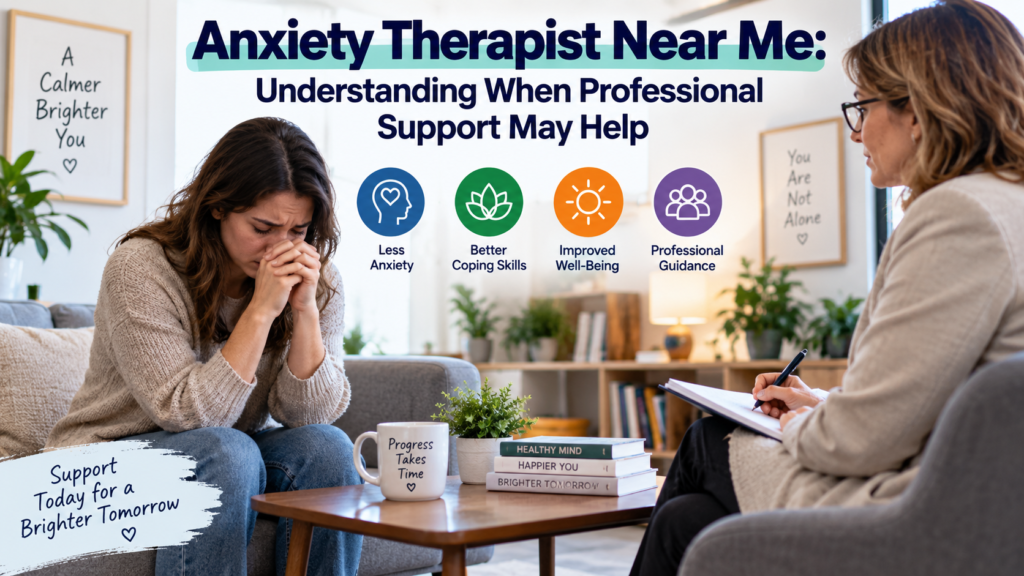

Anxiety is part of being human. Before an interview, important decision, unfamiliar experience, or major change, some nervousness is expected. However, anxiety can become harder to manage when worry feels constant, physical tension rarely settles, or fear begins shaping everyday decisions.
Searching for an Anxiety Therapist Near Me can be a practical first step when anxious thoughts or physical symptoms are interfering with work, relationships, sleep, confidence, or daily routines.
When Everyday Worry Starts Taking Over
Anxiety does not always look dramatic.
It may appear as repeatedly checking decisions, imagining worst-case outcomes, seeking reassurance, avoiding uncomfortable situations, or spending hours mentally reviewing conversations.
Some people experience anxiety primarily through thoughts. Others notice physical symptoms first.
A racing heart, tense muscles, stomach discomfort, restlessness, difficulty sleeping, or feeling constantly on alert may accompany periods of heightened anxiety.
The Avoidance Cycle
Avoidance can provide immediate relief.
Suppose a social situation creates anxiety. Cancelling plans may make the discomfort disappear temporarily, which teaches the brain that avoidance successfully prevented danger.
Unfortunately, that relief can strengthen fear over time.
The next invitation may feel even harder to accept.
Therapy can help individuals understand these cycles and develop more flexible responses rather than allowing anxiety to make increasingly more decisions for them.
Why Anxiety Can Feel So Convincing
Anxious thoughts often focus on possibility.
“What if I fail?”
“What if something goes wrong?”
“What if people judge me?”
Because negative outcomes are technically possible, the thoughts can feel impossible to dismiss. Trying to obtain complete certainty may then produce more checking and rumination.
Therapeutic work can help people distinguish between a possibility and a probability while developing greater tolerance for uncertainty.
Understanding Your Personal Triggers
Anxiety has different triggers for different people.
Workplace expectations may affect one person, while another struggles most with relationships, health worries, social situations, or major decisions.
Identifying triggers can reveal patterns.
Thoughts, Feelings, and Behaviours Are Connected
Imagine receiving a brief message asking to talk later.
One person may interpret it neutrally. Someone experiencing anxiety might immediately assume something bad has happened. That thought creates fear, which may lead to repeated checking or reassurance-seeking.
Understanding this sequence creates opportunities for change.
Instead of automatically accepting the first anxious interpretation, individuals can learn to consider alternative explanations and choose responses more deliberately.
What Happens During Anxiety Therapy?
Therapy is not simply about being told to stop worrying.
A therapist may help someone explore triggers, recognize recurring thought patterns, understand physical responses to stress, and identify behaviours that unintentionally maintain anxiety.
Practical coping strategies may also become part of the process.
The specific approach depends on the individual, their concerns, and what they hope to change.
Progress Does Not Mean Eliminating Every Anxious Feeling
A completely anxiety-free life is neither realistic nor necessary.
Anxiety can sometimes alert people to genuine concerns and encourage preparation. The difficulty arises when the alarm system reacts too strongly or too frequently.
Progress may mean recovering more quickly after anxious moments, avoiding fewer situations, spending less time ruminating, or feeling better able to tolerate uncertainty.
These changes can significantly improve daily life even if occasional anxiety remains.
Taking the Next Step
Persistent anxiety can make the world feel smaller as decisions become increasingly organized around preventing discomfort.
Therapy can provide a structured environment for understanding how anxiety operates and learning ways to respond differently.
Seeking support does not require waiting until symptoms become unbearable. If worry, fear, avoidance, or physical tension consistently interfere with everyday life, exploring therapeutic support may be worthwhile.
With greater awareness and consistent practice, people can develop a different relationship with anxious thoughts—one where anxiety can be acknowledged without automatically being allowed to determine what happens next.