
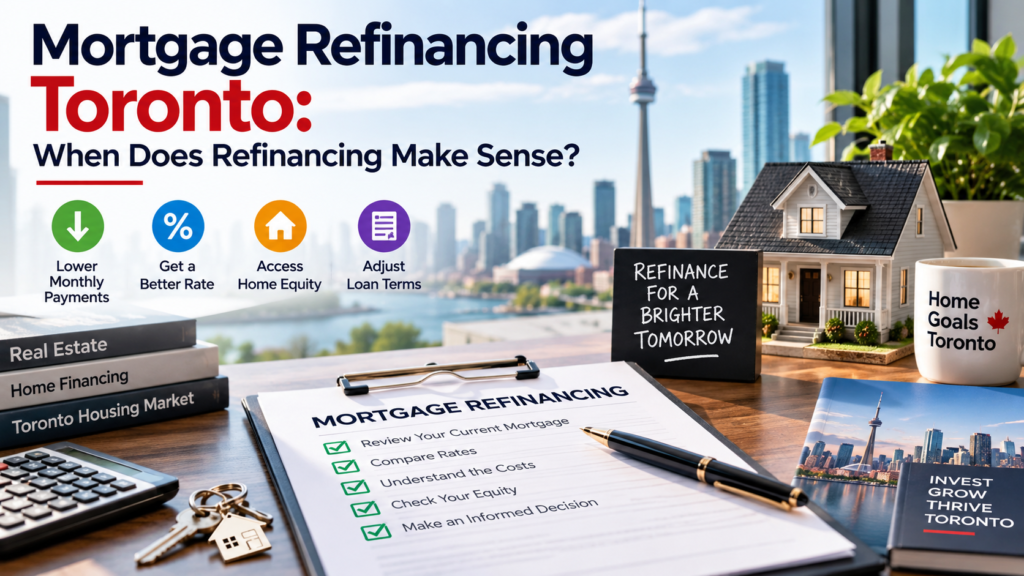

A mortgage does not always need to remain unchanged until the end of its original term. As household finances and priorities evolve, homeowners may consider restructuring their existing borrowing.
However, refinancing is not automatically beneficial. The decision should be based on a clear objective and a careful comparison of potential benefits and costs. Homeowners researching mortgage refinancing Toronto should first understand what refinancing can accomplish.
What Does Mortgage Refinancing Mean?
Refinancing generally involves replacing or restructuring an existing mortgage to create new borrowing terms.
A homeowner might consider this because their financial circumstances have changed, they want access to available home equity, or they wish to reorganize other debts.
Whatever the motivation, refinancing should solve a specific financial problem rather than simply create additional borrowing capacity.
Reasons Homeowners Consider Refinancing
One common reason is debt consolidation. A homeowner carrying several financial obligations may investigate whether reorganizing those debts could simplify monthly payments.
Others consider refinancing to fund significant expenses, renovations, or other long-term financial priorities.
Improving Monthly Cash Flow
Household budgets change over time. Refinancing may sometimes alter monthly mortgage obligations, potentially providing additional cash-flow flexibility.
However, reducing a monthly payment does not necessarily reduce the total borrowing cost.
Extending repayment over a longer period can mean paying interest for longer. Therefore, both short-term affordability and long-term consequences deserve attention.
Accessing Home Equity
As mortgage balances decline and property values change, homeowners may build equity.
Refinancing can potentially allow qualified borrowers to access part of that equity. Yet home equity should not be viewed as free money. Borrowed equity creates debt secured against the property.
Before using it, ask whether the purpose supports your broader financial goals.
Homeowners who want to discuss Toronto-area mortgage options should prepare a clear picture of their existing mortgage and household finances first.
Consider the Costs Before Refinancing
This step is easy to overlook.
Changing a mortgage before its term ends may involve a prepayment penalty or other expenses. Depending on the situation, additional costs may also arise during the refinancing process.
These amounts should be compared with the expected benefit.
Think About Your Break-Even Point
Suppose refinancing is expected to create monthly savings but requires an upfront cost. Calculate how long it would take for those savings to recover the expense.
If you expect to sell the property before reaching that point, refinancing may be less attractive.
Review Your Long-Term Plans
Your future housing plans matter.
Are you likely to remain in your home for several years? Could you move soon? Is your household income expected to change?
Mortgage refinancing Toronto should be evaluated in the context of these questions because a strategy that works for a long-term homeowner may not suit someone expecting a major change soon.
Do Not Use Refinancing to Ignore Spending Problems
Consolidating expensive debts may improve financial organization, but refinancing alone does not change the habits that created recurring balances.
If old debts are moved into a mortgage and then rebuilt, the household can end up carrying even more debt.
A successful refinancing plan should therefore include a realistic budget and a strategy for managing future borrowing.
Review the Complete Picture
Consider your existing mortgage balance, remaining term, current obligations, income stability, equity, future plans, and the expected costs of making a change.
Looking at the complete picture is more useful than focusing on one attractive feature.
Conclusion
Mortgage refinancing Toronto can be worth exploring when it supports a well-defined financial goal. It may help some homeowners reorganize debts, adjust cash flow, or access equity for an important purpose.
Still, refinancing deserves careful analysis. Compare the costs with the expected benefits, consider your timeline, and think about the effect on total debt. When the numbers and long-term objectives align, refinancing can become a deliberate financial strategy rather than simply another borrowing decision.