


You open your website on a busy afternoon and the page just sits there, spinning. A few visitors leave. A customer messages to say the checkout is not loading.
By the next morning everything works again, so you shrug it off, until it happens again next week.
If that sounds familiar, your hosting plan may be the quiet problem. Almost every website starts on cheap shared hosting, and that is a sensible choice on day one. But websites grow, and the plan that carried you through the first months can slowly turn into a ceiling.
This guide covers five clear signs that it is time to move to an offshore VPS, what that move really involves, and how to pick a provider you can trust.
What Is an Offshore VPS and Why Are Website Owners Considering It?
A VPS gives you your own protected slice of a server. The word “offshore” tells you where that server sits and which laws apply to it.
How a VPS Differs from Shared Hosting
On shared hosting, hundreds of websites use the same CPU, memory and bandwidth. It is like living in a crowded house where everyone shares one kitchen.
A VPS (Virtual Private Server) uses virtualization to give you a fixed share of resources that belongs only to you. You also get root access, which means you decide what runs on your server. Think of it as moving into your own apartment inside the same building.
What Offshore Web Hosting?
Offshore simply means your server is hosted in a country different from the one where you or most of your visitors live. Website owners usually choose countries with strong infrastructure and clear privacy rules. The Netherlands is a popular pick because it combines EU data protection standards with excellent connectivity.
Offshore does not mean illegal or shady. You still have to follow the law in your own country and the terms of your hosting provider. What changes is the jurisdiction, the network quality and the level of control you get.
Sign 1: Your Website Slows Down When Traffic Rises
Slow pages cost you visitors, sales and search rankings. If speed drops exactly when more people show up, the server is probably the bottleneck.
Shared Resources Are Usually the Culprit
On a shared plan, one noisy neighbour can eat up the resources your site needs. A sudden traffic spike on another website can slow yours down even if your own traffic is normal.
You may also notice random 503 errors, long loading times in the evening, or an admin panel that crawls. These are classic signs that you have outgrown the plan.
A Quick Way to Check
Run your homepage through a speed tool such as GTmetrix or PageSpeed Insights at different times of the day. Pay attention to Time to First Byte (TTFB). If it swings wildly between tests, the problem is the server and not your theme or images.
How an Offshore VPS Helps
With a VPS, your CPU and RAM are reserved for you, so another customer’s traffic cannot drain them. You can also tune caching, PHP settings and database limits to match your site.
Result: steadier load times, fewer crashes and room to scale when your next campaign goes well.
Sign 2: Your Host Keeps Suspending or Restricting Your Site
A host that suspends your site without a clear reason is more than an annoyance. Every hour offline is lost trust.
Overly Strict Policies on Shared Plans
Many shared hosts rely on automated systems. A traffic spike can be flagged as “resource abuse”, and a harmless page can be flagged by a keyword filter. Some providers also refuse whole categories of legal content, such as forums, file sharing, news commentary or adult sites that follow the law.
If you have received more than one warning, or you spend time arguing with support, that is a strong sign to look at other options.
Why Jurisdiction Changes the Picture
A host works under the laws of the country where it operates. A provider based in a jurisdiction with clear legal process tends to handle disputes in a more predictable way, usually based on proper notices rather than automated guesses.
To be clear, this is not a free pass. Your content must be legal, and a responsible host still acts on valid legal requests. The benefit is fair, predictable treatment instead of sudden shutdowns.
Read the Acceptable Use Policy First
Before you move, read the provider’s Acceptable Use Policy. Check what is allowed, how complaints are handled and how much time you get to respond.
Sign 3: Privacy and Data Control Have Become a Priority
If your website collects any customer data, you are responsible for protecting it. That responsibility grows as your audience grows.
Customer Data Is a Responsibility
Contact forms, orders, user accounts and email lists all hold personal information. Privacy laws such as GDPR expect you to keep that data safe and to know where it is stored.
On a crowded shared server, you have limited visibility into who else is sitting next to your data.
What an Offshore VPS Adds
A VPS gives you an isolated environment with your own firewall rules, your own access keys and the freedom to encrypt what matters. You also choose the country where your data is stored, which helps if you want to keep it under strong privacy law.
This matters for independent publishers, small businesses with sensitive client records, and anyone who simply prefers fewer middlemen.
Basic Privacy Steps After You Move
- Use SSH keys instead of passwords
- Turn on a firewall and close unused ports
- Enable two factor authentication on your control panel
- Keep encrypted backups in a separate location
Sign 4: Your Visitors Are Spread Across the Globe
Websites do not only serve the town where the owner lives. If your analytics show visitors from several countries, server location starts to matter.
Distance Adds Delay
Data travels fast, but not instantly. The farther a visitor is from your server, the longer each request takes. For a single page the difference is tiny, but across dozens of files it adds up to a noticeably slower experience.
Why Central European Hubs Work Well
Amsterdam is home to AMS-IX, one of the largest internet exchange points in the world. That gives servers there short, well connected routes to the UK and Europe, and solid paths to the Middle East, Africa and Asia.
Pair a well placed VPS with a CDN for images and scripts, and visitors in different regions will get a much smoother experience.
Sign 5: You Need Full Control Over Your Server Environment
Some projects simply do not fit inside the limits of a shared plan. When you keep hitting those limits, a VPS is the natural next step.
When Shared Hosting Says No
Shared hosting usually restricts which software you can install. You may be locked to a specific PHP version, blocked from running background processes, or limited on database connections.
If you want to run Node.js, Python apps, Docker containers, a staging site or custom cron jobs, you will quickly feel the walls.
Root Access Changes What Is Possible
With root access you can install the tools you need, configure the server the way your project requires and test changes safely. It does take some technical comfort, but you do not have to do everything in a black terminal.
Control Panel Makes Life Easier
Panels such as DirectAdmin or cPanel let you manage domains, email, databases and backups through a clean dashboard. That means you get the power of a VPS without memorising every command.
How to Choose the Right Offshore VPS Provider?
Not every offshore VPS is built the same. A few checks before you buy can save you a painful migration later.
Check the Data Center and Jurisdiction
Look for a provider that is clear about where its servers are. A Tier III data center is a good sign because it is designed with redundant power and cooling, so maintenance does not require taking servers offline.
Look at Support and Transparency
Test the support team before you buy. Ask a real question and see how fast and how clearly they answer. Also look for plain pricing, a clear refund policy and an easy to read Acceptable Use Policy.
Compare Hardware and Control Panel Options
Check what kind of CPU and storage you will receive, and whether the panel you prefer is available. A modern setup with fast storage makes a bigger difference than a long feature list.
Do Not Choose on Price Alone
The cheapest plan can turn expensive if it brings downtime, slow support or hidden limits. Value comes from the whole package, not only the monthly figure.
QloudHost: Practical Offshore VPS Option for Growing Websites
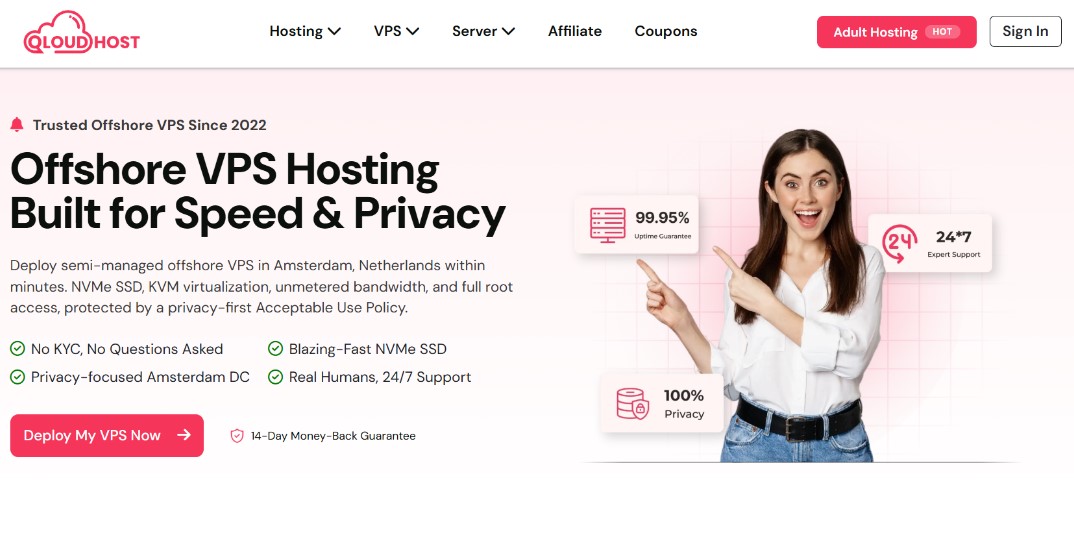
If you are comparing Offshore VPS hosting providers, QloudHost is worth a look. It is a hosting company focused on offshore and privacy minded hosting, with infrastructure based in the Netherlands.
Tier III Data Center in Amsterdam
QloudHost runs from a Tier III data center in Amsterdam. Redundant power and cooling support dependable uptime, and the location gives you the legal and network advantages of the Netherlands.
For website owners with visitors in the UK, Europe and beyond, that is a strong place to keep a server.
Control Panel You Can Actually Use
DirectAdmin is the default control panel on QloudHost plans, and cPanel is available on request if you prefer it. So whether you like a lightweight, fast panel or the one you already know, you can pick what fits your workflow.
That flexibility makes the jump from shared hosting to a VPS far less intimidating.
Who QloudHost Suits Best?
It fits websites that have outgrown shared hosting, businesses that want their data under Dutch and EU jurisdiction, and publishers who want fair treatment of lawful content. Forums, media sites, online stores and web apps are all common examples.
Pricing Worth Checking
QloudHost VPS plans start from around $17.99 per month on a two year term. Prices can change, so check the current offer on the website before you decide.
As with any provider, keep your content lawful and read the terms of service. A good host protects you from unfair shutdowns, but it does not replace responsible publishing.
Frequently Asked Questions
What is an offshore VPS in simple words?
It is a private virtual server hosted in a country different from yours. You get dedicated resources and full control, plus the legal and network benefits of that location.
Is offshore VPS hosting legal?
Yes, hosting your website in another country is legal. You still have to follow your local laws and the provider’s terms, and the content you publish must be lawful.
Will an offshore VPS make my website faster?
Often yes, because your resources are reserved and not shared with other sites. Speed also depends on server location, caching and how well your site is built.
How do I know if shared hosting is no longer enough?
Warning signs include slow pages during busy hours, frequent errors, resource limit warnings and suspensions. If you see two or more, a VPS is worth considering.
Do I need technical skills to manage an offshore VPS?
Basic skills help, but a control panel like DirectAdmin or cPanel handles most daily tasks. For anything complex, a good support team can guide you.
Is moving my website to a new VPS difficult?
Not usually. You copy your files and database, test the site on the new server, then point your domain to it. Planning the switch for a quiet hour keeps downtime close to zero.
Can I host any type of content on an offshore VPS?
No. Content must be legal, and every reputable host has rules and responds to valid legal requests. Offshore hosting gives you jurisdiction and control, not permission to ignore the law.
Conclusion
A website rarely fails all at once. It slows down a little, throws a few errors, gets a warning email, and one day you realise the hosting plan is holding the business back.
If you recognise yourself in these five signs, which are slowdowns under traffic, repeated suspensions, privacy worries, a global audience and a need for full control, an offshore VPS is the logical next step. Choose a provider with a transparent policy, a solid data center and support you can actually reach.
For many growing websites, QloudHost offers that balance, with a Tier III Amsterdam data center, DirectAdmin or cPanel, and VPS plans built for sites ready to leave shared hosting behind.