
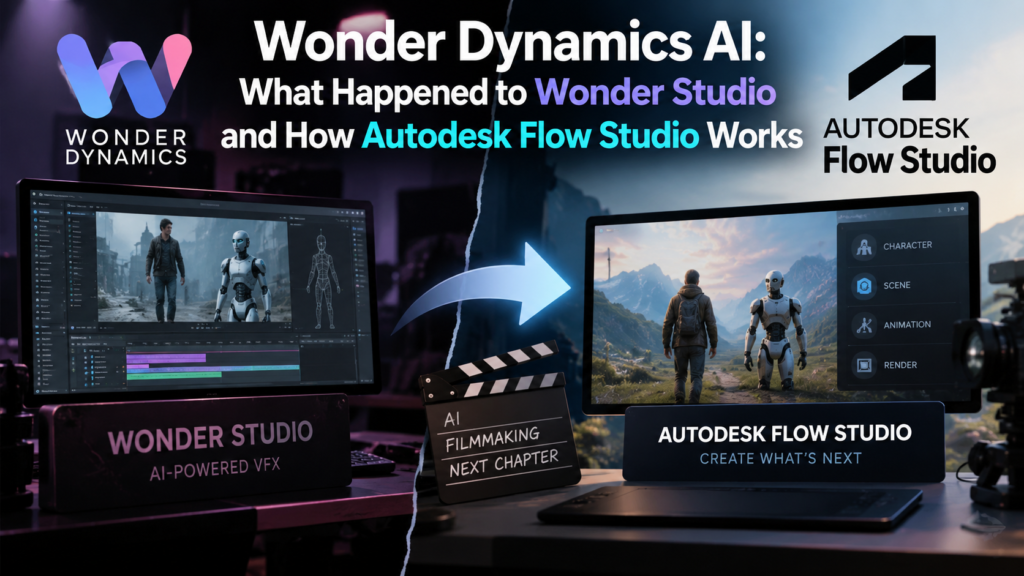

The story of Wonder Dynamics AI is less about a startup disappearing and more about a technology platform being absorbed into a much larger software company. Wonder Dynamics, the company behind Wonder Studio, was acquired by Autodesk in May 2024, bringing its AI-powered visual-effects technology into Autodesk’s Media & Entertainment business.
Today, Wonder Studio is no longer the standalone product name many creators remember. It has evolved into Autodesk Flow Studio, a browser-based platform for AI-assisted animation, visual effects, motion capture, 3D asset creation, and video-to-3D workflows. Autodesk has continued expanding the technology throughout 2026, including a 3D Editor, Canvas workflow, new generative models, and character-generation capabilities.
That makes Wonder Dynamics AI an interesting business case: a specialized creative-AI startup became part of a major professional software ecosystem rather than continuing independently.
Quick Facts
| Detail | Information |
|---|---|
| Company | Wonder Dynamics |
| Founders | Nikola Todorovic and Tye Sheridan |
| Original flagship product | Wonder Studio |
| Acquirer | Autodesk |
| Acquisition announced | May 21, 2024 |
| Acquisition terms | Not publicly disclosed |
| Current product | Autodesk Flow Studio |
| Industry | AI, VFX, 3D animation, media and entertainment |
| Business model | Subscription-based cloud software |
| Current plans | Free, Lite, Standard, Pro and Enterprise |
| Platform | Browser-based, cloud processing |
| Parent company | Autodesk |
What is Wonder Dynamics AI?
Wonder Dynamics AI refers broadly to the artificial intelligence technology Wonder Dynamics developed to automate parts of film, television, advertising, and other visual-effects workflows. Its best-known product was Wonder Studio, a cloud-based platform designed to make it easier to place and animate CG characters inside live-action footage.
Wonder Studio combined AI with established 3D production techniques. Instead of requiring creators to manually handle every stage of character tracking, animation, lighting, and compositing, the system automated much of that work. Autodesk described the technology as a way to reduce the complexity and learning curve associated with 3D character production.
The important distinction is that the technology was not positioned simply as a text-to-video generator. Wonder Dynamics built around a production workflow that let artists still work with editable 3D assets and established digital-content-creation tools. That philosophy helped make the technology relevant to professional VFX pipelines.
What Happened to Wonder Studio and Wonder Dynamics?
The major turning point came on May 21, 2024, when Autodesk announced that it had acquired Wonder Dynamics. The financial terms were not disclosed. At the time, Autodesk said the acquisition would expand its Media & Entertainment portfolio and help more creators use AI to add 3D animated characters to live-action projects.
The founders remained closely associated with the technology. Nikola Todorovic, CEO and co-founder of Wonder Dynamics, joined Autodesk with the team, while actor and producer Tye Sheridan was identified as co-founder and president. Autodesk continues to describe Todorovic as a co-founder of Wonder Dynamics, an Autodesk company, in its 2026 materials.
So, what happened to Wonder Studio? It was not simply shut down. Autodesk gradually integrated and expanded it. In 2025, Autodesk announced the transition to Flow Studio, with new subscription tiers and Autodesk-based account management. The Wonder Dynamics website and standalone sign-up process were retired from August 12, 2025, with users directed toward Autodesk Flow Studio.
For existing users, the transition was designed to preserve projects, assets, and content for those who continued using the same email address with an Autodesk account. Autodesk also confirmed that the former Wonder Dynamics support expertise continued within the Flow Studio team.
In other words, Wonder Dynamics became an Autodesk business rather than an independent AI startup.
How Autodesk Flow Studio Works
Autodesk Flow Studio is the current form of the technology associated with Wonder Dynamics AI. It runs through a desktop browser and uses cloud processing, so users don’t need a high-end local workstation to do every computationally intensive task. Chrome and Safari are currently supported, while mobile browsers are not yet optimized for the platform.
The original core workflow remains particularly useful for live-action VFX. A creator can upload Video, identify or replace actors with CG characters, and allow the platform’s AI systems to generate elements such as animation, camera tracking, and clean plates. Flow Studio also supports markerless AI motion capture, which extracts movement from Video without requiring traditional motion-capture suits or physical markers.
The platform now goes beyond its original live-action character-replacement concept. Autodesk has added tools for creating 3D assets, including image-to-3D and text-to-3D capabilities. The Image to 3D Wonder Tool can reconstruct a 3D mesh from a single image and export assets for external 3D workflows.
Another major development is Video to 3D Scene technology. Rather than treating footage solely as a flat video sequence, Flow Studio can reconstruct cameras, characters, and environments into a 3D scene. This expands the product’s usefulness from automated VFX assistance toward broader previsualisation, animation and virtual-production workflows.
The Business Model Behind Flow Studio
The commercial model has shifted toward a conventional SaaS structure. Flow Studio currently offers Free, Lite, Standard, Pro and Enterprise tiers. The free plan provides 300 credits per month, while higher tiers increase credits, storage, video limits, character uploads, and professional export capabilities. Enterprise pricing is handled through sales.
This structure matters because AI video and 3D processing can be computationally expensive. A credit-based model lets Autodesk tie usage to processing capacity rather than offering unlimited generation at a fixed, consumer-style price.
The product is also strategically connected to Autodesk’s wider Media & Entertainment portfolio. Flow Studio can work alongside tools such as Maya and Blender, while higher-level workflows include scene exports and professional production formats. Autodesk has therefore positioned the technology less as an isolated AI experiment and more as another component in a professional creative pipeline.
For Autodesk, the acquisition potentially provides another route into AI-assisted content creation while giving Wonder Dynamics access to a much larger software ecosystem and customer base. The acquisition price was not disclosed, so treat claims about Wonder Dynamics’ financial return or valuation with caution.
What Makes Flow Studio Different From Other AI Video Tools?
Wonder Dynamics AI’s strongest distinction is its connection to traditional 3D production.
Many generative AI video products focus primarily on producing finished-looking clips from text, images, or reference material. Flow Studio takes a more production-oriented approach. Its workflows are designed around characters, animation, camera information, clean plates, 3D assets, and exports that can continue into established digital-content-creation software.
That distinction is important for professional filmmakers and VFX artists. A production pipeline often requires more than an attractive final frame. Artists may need to adjust animation, replace assets, change camera behavior, refine lighting, or move elements into another application.
Autodesk has continued moving Flow Studio in this direction. In August 2026, it introduced a 3D Editor and Canvas workflow that lets users build cinematic scenes in the browser using characters, animations, cameras, and worlds. The 3D Editor is intended to provide more direct 3D control, while Canvas retains a faster 2D-oriented workflow.
The platform also added Character LoRA Training in June 2026 to improve consistency for character-specific video generation, alongside continued improvements in identity preservation across different views, poses, and camera changes.
Current Position and Business Challenges
The evolution from Wonder Studio to Flow Studio gives Autodesk a potentially valuable position at the intersection of AI and professional media production. The company already owns major tools used in 3D design and visual effects, including Maya. Bringing Wonder Dynamics into that ecosystem creates opportunities for tighter workflows between AI-assisted creation and conventional production software.
But there are also limitations. Flow Studio remains dependent on cloud processing, usage credits, and supported workflows. Autodesk’s documentation currently limits uploaded projects to certain video formats and specifies a maximum processed video length of two minutes, with other constraints around shots and transitions.
The competitive challenge extends beyond traditional VFX software. Generative video companies are moving quickly, while established creative applications are incorporating AI into their own products. The strategic question for Autodesk is therefore not simply whether Flow Studio can automate individual VFX tasks, but whether it can become a useful production layer that artists repeatedly return to.
The acquisition also illustrates a broader pattern in the AI market: specialist startups can provide differentiated technology, but integration into an established professional software ecosystem may determine how widely that technology is ultimately adopted.
What Is Next for Wonder Dynamics AI?
The clearest evidence of the platform’s direction is Autodesk’s recent product development. During 2026, Flow Studio added asset generation, AI rigging, character-specific training, expanded AI model support, improved motion capture, and the 3D Editor plus Canvas workflow.
Autodesk has also expanded the number of AI models accessible through Flow Studio, including models for video, image, and 3D generation. That suggests the platform is developing into an AI-assisted creative workspace rather than remaining narrowly focused on the original Wonder Studio character-replacement workflow.
Still, future performance should not be treated as guaranteed. The market is moving quickly, and creators ultimately judge these tools on consistency, controllability, export quality, workflow compatibility, and cost. Flow Studio’s long-term opportunity will depend on whether Autodesk can combine AI convenience with the precision expected in professional production.
Conclusion
The story of Wonder Dynamics AI is fundamentally a story of integration rather than disappearance. Autodesk acquired Wonder Dynamics in 2024, and Wonder Studio subsequently evolved into Autodesk Flow Studio, bringing the original company’s AI-powered VFX technology into a much broader professional software ecosystem.
For users searching for Wonder Studio today, Flow Studio is the relevant product to investigate. Its capabilities now extend beyond automated character replacement into markerless motion capture, 3D asset generation, Video to 3D Scene, AI-assisted animation, and browser-based scene creation.
The bigger business significance is Autodesk’s attempt to connect generative AI with established creative production rather than treating AI as a standalone novelty. If that approach succeeds, Flow Studio could become a key bridge between fast AI generation and the editable, controlled workflows professional filmmakers and VFX artists still require.
For more business news, company profiles, financial insights, and latest updates, visit DailyInfoz.co.uk.
(FAQs)
What happened to Wonder Studio?
Wonder Dynamics developed Wonder Studio and later became part of Autodesk after the company acquired Wonder Dynamics in May 2024. The product subsequently evolved into Autodesk Flow Studio, which remains actively developed.
Is Wonder Dynamics still a company?
Wonder Dynamics is now an Autodesk company, not an independent startup. Autodesk continues to identify Nikola Todorovic as co-founder of Wonder Dynamics, an Autodesk company, while its former technology operates through Flow Studio.
What is Wonder Dynamics AI used for?
Wonder Dynamics AI technology supports AI-assisted VFX, character animation, markerless motion capture, camera tracking, clean-plate generation, and 3D production. Its current implementation is Autodesk Flow Studio, which has expanded into broader 3D and generative workflows.
Is Autodesk Flow Studio the same as Wonder Studio?
Yes. Autodesk describes Flow Studio as the former Wonder Studio, created by Wonder Dynamics. The product has since been expanded with additional AI, 3D, and creative-production capabilities.
How much does Autodesk Flow Studio cost?
Flow Studio has Free, Lite, Standard, Pro, and Enterprise plans. The Free tier currently provides 300 credits per month, while paid plans provide progressively higher usage limits and capabilities; Enterprise pricing is available through Autodesk sales.
Is Wonder Dynamics AI still being developed in 2026?
Yes, although the technology is now developed under the Autodesk Flow Studio brand. Autodesk’s 2026 release notes show continuing additions, including Character LoRA Training, AI asset creation, expanded model support, a 3D Editor and Canvas, and other workflow improvements.