
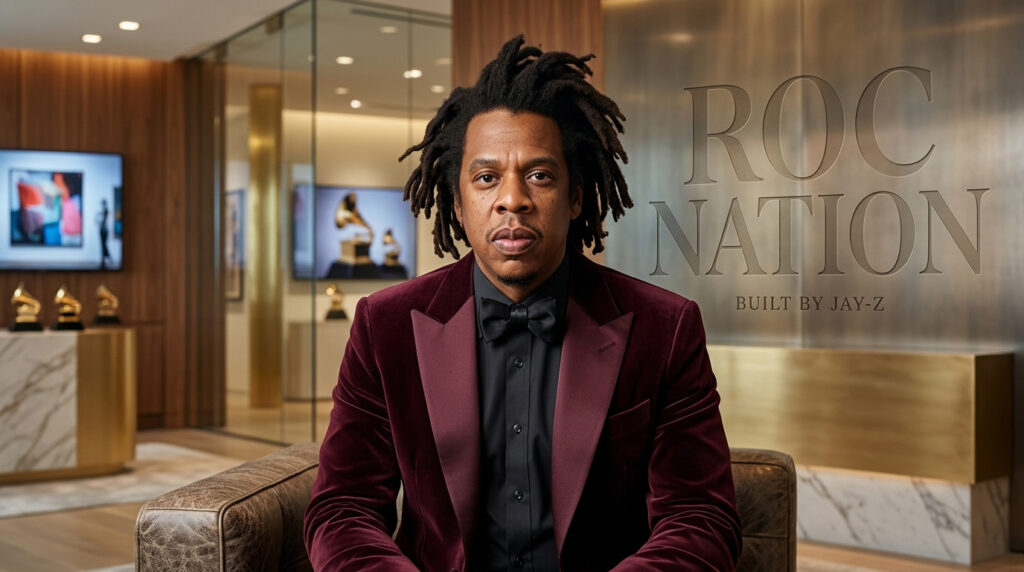

Roc Nation has grown far beyond the traditional record-label model. Founded in 2008 by Shawn “Jay-Z” Carter and a group of longtime business associates, the company has built operations across music, artist management, publishing, sports, touring, media, distribution and brand partnerships. Its development reflects a broader shift in entertainment, where talent companies increasingly participate in several parts of an artist’s or athlete’s commercial career rather than relying on one source of income.
For Jay-Z, the strategy has also been part of a much larger business career. His personal wealth comes from music rights, investments, spirits, technology and other ventures, so his estimated net worth should not be confused with the value of the private company itself. This article examines how the business works, who controls it, its major divisions, financial picture, competitive position and what could shape its future.
Quick Facts
| Detail | Information |
|---|---|
| Company | Roc Nation |
| Industry | Entertainment, music, sports and media |
| Founded | 2008 |
| Key founder | Jay-Z |
| Other founding executives | Desiree Perez, Jay Brown, Juan Perez and Tyran “Ty Ty” Smith |
| Chairman | Jay-Z |
| CEO | Desiree Perez |
| Main base | New York City |
| Sports division | Roc Nation Sports |
| Business model | Management, music, publishing, sports representation, touring, media, distribution and partnerships |
| Ownership | Privately held; exact ownership percentages are not publicly disclosed |
| Jay-Z net worth | Estimated at $2.8 billion by Forbes in 2026 |
How Roc Nation Became a Major Entertainment Business
The company was founded in 2008, when Jay-Z entered a major long-term partnership with Live Nation. The agreement was widely reported as a roughly $150 million, 10-year deal covering recordings, touring, and other entertainment activities. A contemporaneous SEC filing confirmed the creation of Roc Nation LLC through a relationship involving Live Nation and Marcy Media, an entity associated with Jay-Z.
The original concept was important because it moved away from treating an artist’s career as a collection of disconnected activities. Music releases, concerts, publishing, sponsorships and other commercial opportunities could be developed through a broader entertainment structure.
That approach became increasingly relevant as streaming changed recorded music economics. Artists and entertainers now generate value through a mixture of intellectual property, live performances, social influence, endorsements, licensing and direct-to-consumer activity. A company that can coordinate these areas can create more commercial opportunities for the talent it represents.
Over time, the business expanded into sports and media. That diversification has reduced its dependence on traditional music-label economics and helped turn the organisation into a broader talent and entertainment platform.
Roc Nation’s Business Model Explained
The company’s business model is based on representing talent and developing commercial opportunities around that talent. Its activities include artist management, recorded music, publishing, touring, sports representation, distribution, media production and brand partnerships.
Management is particularly significant because it can connect several revenue-producing activities. An artist may earn money from streaming and recordings while also generating income from touring, sponsorships, merchandise, publishing rights and appearances. A management organisation can help coordinate those opportunities and negotiate commercial relationships.
Publishing represents another important part of the model. Music publishing involves rights associated with compositions and songwriting, which can generate royalties when music is used commercially. Recorded music operates through a different set of rights connected to recordings themselves.
The organisation also has a direct-to-consumer component through its online store, where it can sell music releases, merchandise, and other products directly to fans. This provides another route to monetise intellectual property and audience loyalty without depending entirely on third-party retail channels.
Sports adds a different but related business. Athlete representation creates opportunities around contracts, endorsements, personal branding, marketing and other commercial activities. Together, the two businesses give the company exposure to two enormous entertainment markets: music and professional sports.
Who Owns Roc Nation?
The business is privately held, meaning there is no public stock-market record showing a current breakdown of its ownership percentages. Jay-Z remains chairman and a central figure behind the organisation, but it would be inaccurate to claim he owns a specific percentage without reliable public documentation.
Live Nation has also played an important corporate role in the company’s history. The relationship between the two organisations dates back to the original 2008 arrangement and has continued through corporate connections involving various Roc Nation entities.
Desiree Perez serves as CEO. She is one of the company’s founding executives and previously served as chief operating officer before becoming chief executive in 2019. Jay Brown, Juan Perez and Tyran “Ty Ty” Smith are also closely associated with the company’s founding leadership.
The leadership structure helps explain why the organisation has expanded beyond music. Its growth has required expertise in contracts, artist management, sports, touring, media production and corporate partnerships rather than simply record promotion.
Music, Sports and Media Operations
Music remains central to the business. The organisation works across artist management, publishing, recorded music, touring and distribution, allowing it to participate in multiple stages of the entertainment value chain.
Its roster and historical relationships have included major artists, while the broader operation has also worked with songwriters and producers. The objective is not simply to release music but to build sustainable commercial careers around creative talent.
Sports became a major area of expansion with the creation of Roc Nation Sports in 2013. The division represents athletes and has built relationships across American professional sports and international football.
The sports business is strategically attractive because athletes increasingly operate as brands. A successful player can create value through salary negotiations, sponsorships, social media, merchandise, appearances and other commercial activities. Representation therefore extends beyond negotiating an employment contract.
The media side adds another layer. Film and television production, branded entertainment and content development allow the organisation to participate in storytelling and intellectual-property opportunities outside traditional music releases.
These divisions are interconnected. A musician can join a sports campaign, an athlete can enter a brand partnership, and entertainment projects can give clients additional exposure. That cross-platform capability is one of the organisation’s more distinctive characteristics.
Jay-Z’s Net Worth and the Company’s Financial Picture
Jay-Z’s personal fortune is frequently used when discussing the financial scale of his business empire, but the two should be separated.
Forbes estimated Jay-Z’s net worth at approximately $2.8 billion in 2026. That figure represents his overall personal wealth rather than a valuation of the entertainment company. His assets have included music interests, investments and major stakes or transactions involving businesses such as Armand de Brignac and D’Ussé.
Because the company is privately held, no public financial statement shows its full annual revenue, operating profit, or current valuation. Consequently, treat online claims about a precise corporate valuation cautiously unless they tie to a documented transaction or reliable financial source.
This distinction matters especially in celebrity-business coverage. A founder’s net worth can include dozens of unrelated investments, while a company’s enterprise value depends on its own assets, liabilities, earnings potential and ownership structure.
The broader strategy nevertheless has clear economic logic. Owning or managing valuable intellectual property and representing high-profile talent can produce recurring commercial opportunities, while diversification can reduce dependence on any single entertainment segment.
Competitive Position and Business Advantages
The entertainment market contains powerful competitors in virtually every part of the company’s operation. Traditional music groups such as Universal Music Group, Sony Music Entertainment and Warner Music Group compete for artists and intellectual property. In contrast, management and sports agencies compete for the same high-value talent.
The organisation’s advantage is not necessarily its size in every individual category. Its differentiation comes from combining multiple entertainment services under one corporate umbrella and linking them with Jay-Z’s wider business network.
That structure can be particularly valuable for talent looking for opportunities beyond a record contract or sports representation agreement. An artist or athlete may benefit from access to marketing, partnerships, media, touring and brand development through connected teams.
There are also limitations. A diversified entertainment business is operationally complex. It must maintain relationships with artists, athletes, brands, leagues, distributors and media companies while managing reputation across several industries.
Competition for elite talent is another permanent pressure. Successful entertainers and athletes have considerable negotiating power, and rival agencies can offer attractive financial terms, global reach or specialised expertise.
2026 Developments and Future Outlook
The business entered 2026 with continued activity across live entertainment, sports and music. Its involvement in major live events and Jay-Z-related projects has reinforced the commercial value of combining legacy music assets with contemporary touring and fan engagement.
Sports is another area with international growth potential. The agency’s activity in European football shows how the business has expanded beyond the United States into a market where player representation, transfers, sponsorships, and personal branding overlap.
Its involvement in major entertainment partnerships also illustrates a broader strategy: instead of competing only for music-market share, the company can participate in large cultural and commercial projects where music, sports and hospitality intersect.
Future performance will depend on maintaining a strong talent roster, developing intellectual property, securing commercially attractive partnerships and adapting to changes in streaming, live entertainment and sports media.
A broader question also remains about succession and diversification. Much of the company’s public identity remains closely associated with Jay-Z. Building durable corporate value that extends beyond one founder’s celebrity profile could become increasingly important as the organisation continues to mature.
Conclusion
Roc Nation has evolved from a venture built around Jay-Z’s 2008 Live Nation partnership into a diversified entertainment business covering music, publishing, management, sports, media, touring and commercial partnerships. Its key feature is how these activities connect, allowing the organisation to develop multiple business opportunities around talent and intellectual property.
Jay-Z remains chairperson and a central figure, while CEO Desiree Perez has played a major role in the company’s operational expansion. The business is privately held, so its precise revenue, profit and valuation are not publicly established in the same way as those of a listed corporation.
Jay-Z’s estimated $2.8 billion personal fortune provides useful context for the scale of his wider business interests, but it should not be treated as the company’s valuation. Roc Nation’s long-term opportunity lies in continuing to combine music, sports, media, and strategic partnerships while building a business that can stand on its own beyond any single artist or celebrity.
For more business news, company profiles, financial insights, and latest updates, visit DailyInfoz.co.uk.
(FAQs)
What exactly does Roc Nation do?
Roc Nation operates across music, artist management, publishing, recorded music, touring, sports representation, media, distribution, merchandising and commercial partnerships. Its model is designed to create multiple business opportunities around artists, athletes and entertainment properties.
Who is the CEO of Roc Nation?
Desiree Perez is the CEO of Roc Nation. She is a founding executive who previously served as chief operating officer and became chief executive in 2019.
Is Roc Nation publicly traded?
No. Roc Nation is a private entertainment company and does not have a standalone publicly traded stock. Investors therefore cannot purchase shares of the business through a public stock exchange.
How does Roc Nation make money?
Roc Nation generates revenue through artist and athlete representation, management services, music publishing, recordings, touring, distribution, merchandise, media projects, and commercial partnerships. Its private status means a complete public breakdown of revenue by business segment is not available.
How much is Jay-Z worth in 2026?
Forbes estimated Jay-Z’s net worth at $2.8 billion in 2026. That figure represents his broader personal wealth and should not be interpreted as the valuation of Roc Nation itself.
Is Roc Nation expanding beyond music?
Yes. Roc Nation has built significant operations in sports, media and international entertainment. Its sports representation business has expanded into major American leagues and European football, while its media and partnership activities broaden its reach beyond recorded music.