
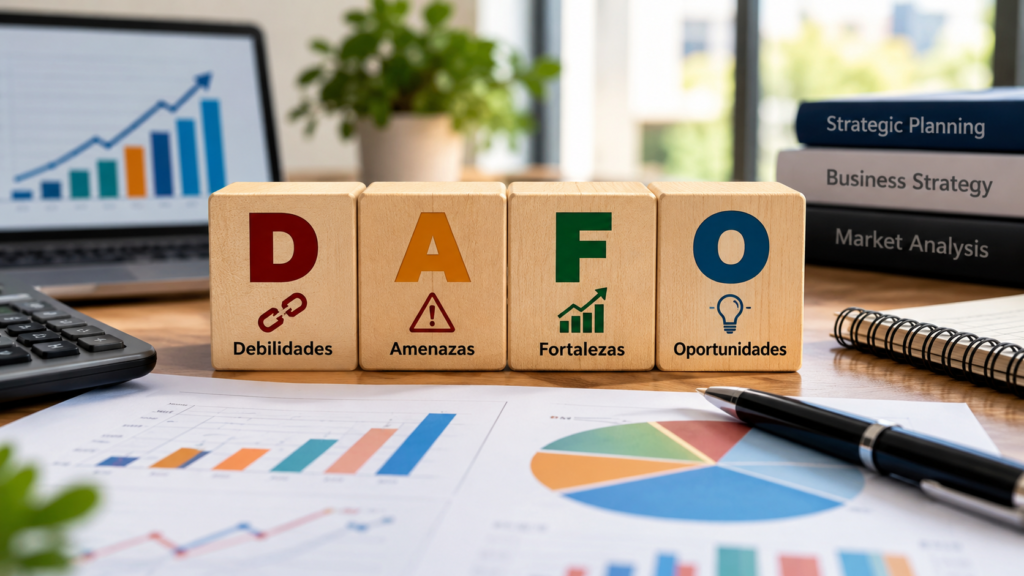

DAFO analysis is a strategic planning method that helps businesses, entrepreneurs, students, and organizations understand their current position and make better decisions. It examines four essential factors: Debilidades (weaknesses), Amenazas (threats), Fortalezas (strengths), and Oportunidades (opportunities). These Spanish terms correspond to the four elements of SWOT analysis, a widely used framework for evaluating internal capabilities and external conditions.
The main purpose of dafo analysis is to identify what an organization does well, where it needs improvement, which opportunities it could pursue, and what risks might affect its objectives. Instead of relying on assumptions, decision-makers can use this framework to organize evidence and develop practical strategies.
Although the method is especially popular in Spanish-speaking business environments, its principles apply to companies, marketing campaigns, personal development, educational projects, and nonprofit organizations. Understanding how the four elements work together makes the framework more useful than simply listing advantages and disadvantages.
What Is DAFO Analysis?
DAFO analysis is a structured evaluation of the internal and external factors that influence a business, project, or individual objective. It provides a snapshot of the current situation and helps identify areas that require attention.
The acronym comes from four Spanish words:
-
Debilidades: Weaknesses or internal limitations.
-
Amenazas: Threats or external risks.
-
Fortalezas: Strengths or internal advantages.
-
Oportunidades: Opportunities or favorable external developments.
In English, the equivalent framework is generally called SWOT analysis, representing strengths, weaknesses, opportunities, and threats. Both approaches examine the same four categories, although DAFO places them in a different order.
The framework works best when it addresses a clearly defined objective. For example, a company might evaluate whether to launch a new product, enter a different market, improve customer retention, or invest in digital marketing.
Without a specific objective, the findings can become a collection of general observations rather than useful strategic information.
The Four Elements of DAFO Analysis
Understanding each component is essential to conducting a meaningful assessment. The four categories should be considered separately before their relationships are examined.
1. Debilidades: Weaknesses
Weaknesses are internal factors that reduce an organization’s ability to achieve its goals. They may include limited funding, outdated equipment, insufficient staff training, inefficient processes, weak brand recognition, or inconsistent customer service.
For example, a small online retailer might have attractive products but struggle with slow deliveries and an unreliable inventory system. These operational problems are weaknesses because they arise within the business and can often be addressed through internal improvements.
A useful dafo analysis identifies weaknesses honestly rather than minimizing them. Decision-makers should examine customer feedback, employee observations, financial records, sales performance, and operational data.
Not every limitation needs immediate attention. The most important weaknesses are those that significantly affect the organization’s objectives or prevent it from taking advantage of promising opportunities.
2. Amenazas: Threats
Threats are external conditions that could damage performance or make objectives more difficult to achieve. Examples include new competitors, economic uncertainty, changing customer preferences, supply-chain disruptions, regulatory changes, and technological developments.
Consider a local clothing retailer competing with international online marketplaces. Lower prices and faster delivery from those competitors could threaten its sales, even if the retailer manages its own operations efficiently.
Unlike internal weaknesses, external threats cannot always be eliminated directly. However, organizations can monitor them, prepare contingency plans, diversify suppliers, improve customer loyalty, or adapt their business models.
An effective dafo analysis distinguishes a genuine threat from a remote possibility. The assessment should consider both the likelihood of an event and its potential impact, helping managers prioritize the risks that matter most.
3. Fortalezas: Strengths
Strengths are internal resources, capabilities, or characteristics that support an organization’s success. These might include experienced employees, strong customer relationships, distinctive products, reliable operations, proprietary technology, or a recognizable brand.
For instance, a neighborhood bakery may have loyal customers, high-quality ingredients, and a reputation for personalized service. These strengths could help it compete against larger businesses that offer broader product ranges but less personal attention.
Businesses should identify strengths using evidence rather than assumptions. Repeat purchases, customer reviews, employee expertise, profit margins, and operational performance can reveal where an organization has a genuine advantage.
The goal of dafo analysis is not simply to celebrate strengths. It is to understand how those strengths can support future decisions, create differentiation, and help the organization respond to external changes.
4. Oportunidades: Opportunities
Opportunities are favorable external developments that an organization may be able to use to achieve its objectives. Examples include emerging customer needs, new distribution channels, changes in consumer behavior, underserved markets, and advances in technology.
A small clothing brand, for example, might identify growing interest in personalized apparel and begin offering customizable products through its website. The opportunity comes from a market need, while the company’s design capabilities may help it respond.
However, an opportunity is not the same as a guaranteed outcome. Businesses must assess demand, costs, competition, and their ability to deliver before committing resources.
In a practical dafo analysis, each opportunity should be connected to a potential action. This prevents the assessment from becoming an optimistic list of trends without a realistic plan for exploiting them.
DAFO Analysis Example for a Small Business
Imagine a small online clothing store that wants to increase sales and expand its customer base. The following example illustrates how the four categories might apply.
| Category | Example findings |
|---|---|
| Strengths | Distinctive designs, loyal customers, flexible product selection |
| Weaknesses | Limited marketing budget, low brand awareness, small inventory |
| Opportunities | New social media audiences, niche product demand, additional sales channels |
| Threats | Established competitors, rising shipping costs, changing consumer spending |
This example shows how the categories describe different aspects of the same business situation.
The store could use its distinctive designs to target a specific customer group. It might address low brand awareness through focused content marketing and improve inventory planning before expanding into additional sales channels.
At the same time, it should monitor shipping costs and competitor pricing. If rising delivery expenses threaten profitability, the business could negotiate with suppliers, adjust its product range, or review its shipping policies.
The value of dafo analysis becomes clearer when the findings lead to decisions. A completed table is only the starting point; the real benefit comes from determining which actions are feasible, affordable, and likely to advance the business objective.
How to Conduct DAFO Analysis Step by Step
A reliable assessment requires preparation, evidence, and a clear process. The following steps help turn the framework into a practical planning exercise.
Step 1: Define the objective
Begin by identifying exactly what you want to evaluate. The objective might involve improving profitability, launching a product, entering a new market, or increasing customer satisfaction.
A narrow objective produces more relevant findings than a vague goal such as improving the entire business.
Step 2: Gather relevant information
Collect evidence from sources such as financial statements, customer surveys, employee feedback, market research, competitor activity, and operational reports.
The quality of dafo analysis depends heavily on the reliability of the information being assessed. Unsupported assumptions can lead to misleading conclusions.
Step 3: Identify internal factors
List the strengths and weaknesses that affect the objective. Consider resources, skills, processes, finances, customer relationships, and product quality.
Where possible, support each finding with specific evidence. For example, documented delivery delays are more useful than a general statement that operations need improvement.
Step 4: Examine external conditions
Identify opportunities and threats arising from the market, economy, competition, technology, customer behavior, and relevant regulations.
Research should distinguish current developments from predictions. A market trend may create an opportunity, but its commercial value should be tested before major investments are made.
Step 5: Prioritize the findings
Not every factor deserves equal attention. Rank findings according to their potential impact, urgency, likelihood, and relationship to the objective.
This step is particularly important when an organization has limited money, time, or staff.
Step 6: Develop an action plan
Translate the most important findings into specific actions. Assign responsibility, establish deadlines, identify required resources, and define measurable outcomes.
A useful dafo analysis should help answer what happens next, who will take action, and how progress will be evaluated.
Step 7: Review and update the assessment
Business conditions change, so the framework should not be treated as a permanent description of the organization. Review the findings when market conditions shift, new information becomes available, or strategic priorities change.
Benefits and Limitations of DAFO Analysis
One major advantage of dafo analysis is its simplicity. The framework provides an accessible way to organize complex information and encourage discussion among people with different perspectives.
It can also help organizations identify competitive advantages, recognize operational problems, evaluate possible investments, and prepare for external risks. Because the method is flexible, it can be applied to projects of different sizes and across many industries.
However, the framework has limitations. A list of strengths and opportunities does not automatically reveal which strategy will succeed. Findings may be subjective, incomplete, outdated, or influenced by the personal opinions of the people conducting the assessment.
Another common problem is failing to distinguish internal factors from external ones. For example, a company’s outdated website is generally an internal weakness, whereas a competitor introducing a superior online service may represent an external threat.
Research from the Chartered Institute of Personnel and Development also emphasizes that meaningful SWOT work requires careful evaluation and discussion, not merely filling in four categories.
To improve the quality of dafo analysis, involve people with different responsibilities, verify important claims, and prioritize findings using evidence. Combine the framework with financial analysis, customer research, competitor assessment, or PESTLE analysis when the decision requires a deeper understanding of external conditions.
DAFO Analysis vs. SWOT Analysis
DAFO and SWOT analysis use the same four-factor framework. Their primary difference is the language and order of the terms rather than the underlying strategic concept.
| Feature | DAFO | SWOT |
|---|---|---|
| Language | Spanish | English |
| Acronym | Debilidades, Amenazas, Fortalezas, Oportunidades | Strengths, Weaknesses, Opportunities, Threats |
| Internal factors | Weaknesses and strengths | Strengths and weaknesses |
| External factors | Threats and opportunities | Opportunities and threats |
| Main purpose | Strategic evaluation | Strategic evaluation |
Both methods help identify internal capabilities and limitations alongside external opportunities and risks. Neither approach is inherently better simply because of its acronym.
When reviewing international business documents, readers may encounter DAFO, SWOT, or the Spanish phrase análisis DAFO. Recognizing the equivalent terminology helps avoid confusion when comparing strategic planning materials across languages.
Conclusion
DAFO analysis is a practical strategic planning framework for understanding an organization’s internal capabilities and the external conditions that influence its objectives. By examining weaknesses, threats, strengths, and opportunities, decision-makers can develop a clearer picture of their current position.
Its effectiveness depends on honest assessment, reliable evidence, meaningful prioritization, and follow-through. Rather than treating the framework as a finished strategy, use its findings to guide decisions, assign responsibilities, and monitor progress over time.
When supported by research and combined with appropriate planning tools, dafo analysis can provide a useful foundation for business growth, risk management, project evaluation, and personal development.
(FAQs)
What does DAFO stand for?
DAFO stands for Debilidades, Amenazas, Fortalezas, Oportunidades. These Spanish words mean weaknesses, threats, strengths, and opportunities. The framework is equivalent to SWOT analysis in English.
What is the main purpose of DAFO analysis?
The main purpose of dafo analysis is to evaluate internal strengths and weaknesses alongside external opportunities and threats. The findings help individuals and organizations make informed decisions and develop practical strategies.
Can DAFO analysis be used for personal development?
Yes. Individuals can use the framework to assess their skills, limitations, career opportunities, and potential obstacles. For example, someone considering a career change could evaluate existing qualifications, training needs, job-market demand, and competition.
Is DAFO analysis the same as SWOT analysis?
Yes. Both frameworks examine the same four strategic factors. DAFO uses Spanish terminology and a different letter order, while SWOT uses the English terms strengths, weaknesses, opportunities, and threats.
How often should DAFO analysis be updated?
There is no universal schedule. Businesses may review their assessment during annual planning, quarterly strategy reviews, major product launches, or significant market changes. The appropriate frequency depends on how quickly relevant conditions change.
What is the biggest mistake when conducting DAFO analysis?
One of the most common mistakes is creating a list without converting the findings into decisions. An assessment becomes useful when the organization prioritizes the most important factors, assigns actions, and measures results.